

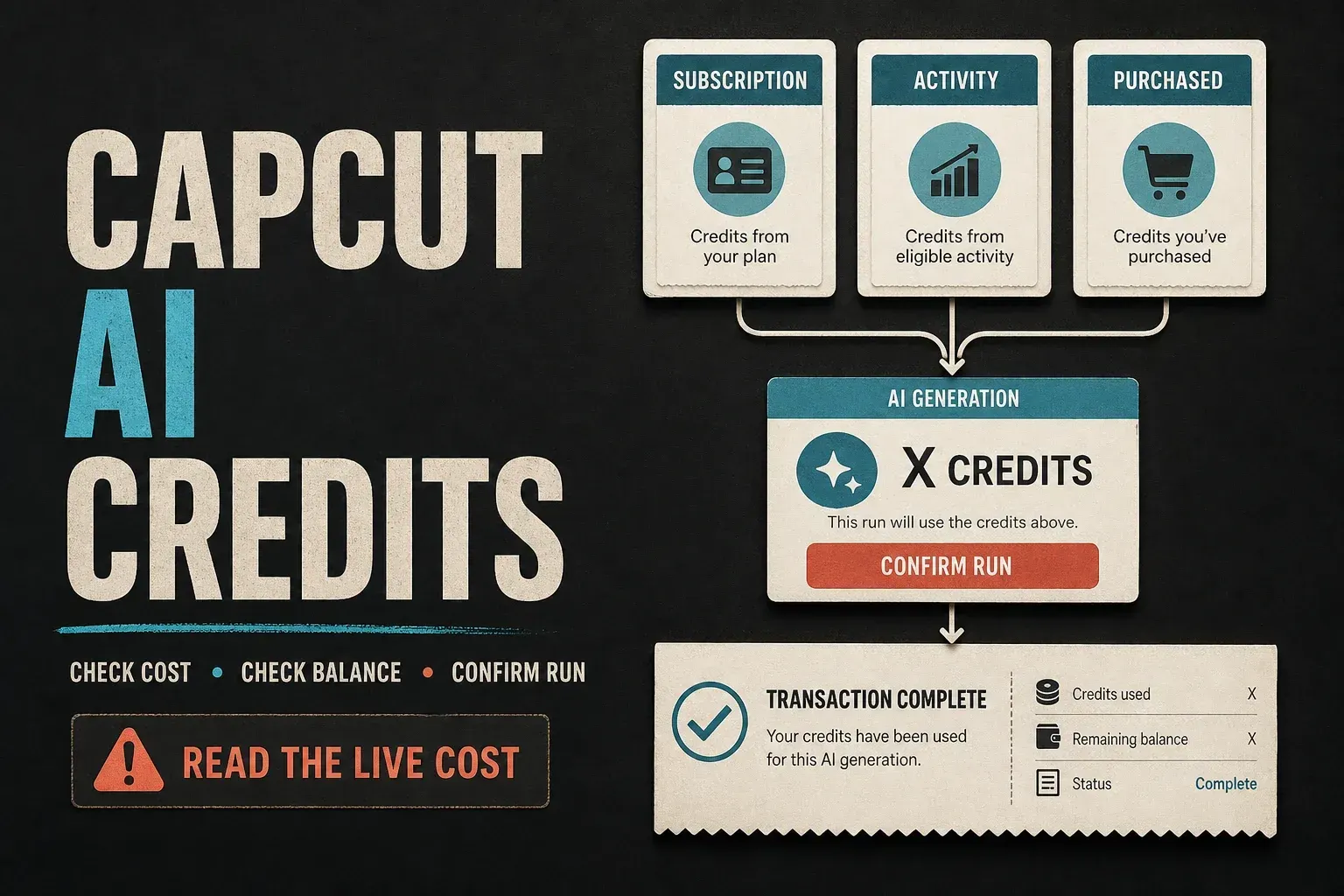
CapCut AI credits pay for eligible AI operations, separately from your subscription. Pro access doesn't make every generation unlimited. To price a job, read the credit charge for that specific action; to price one purchased credit, divide the pack's final cost by the number of credits it contains.
Checked September 14, 2026. CapCut's public pages still disagree about expiry, spending order and purchase routes. This guide documents those disagreements rather than choosing the most generous answer. We reviewed public documentation, not a signed-in checkout, credit purchase or paid generation.
Do you need Pro to buy or use credits?
You don't always need Pro to buy credits. The CapCut Credit Rules explicitly let non-Pro members purchase them. But buying a balance doesn't necessarily unlock a Pro-only tool. Check access before paying for a pack.
A subscription and a credit balance answer different questions: whether your account can open the tool, and how many metered operations it can run. The CapCut Pro guide covers plan access; our Free, Standard and Pro comparison covers subscription prices and benefits.
Don't assume every subscriber receives the same allowance. The Credit Rules say Pro plans receive equal monthly grants, while CapCut's plan-specific guidance says allocations differ. Its Pro upgrade announcement names an increase from 550 to 1,200 AI points. That announcement doesn't establish the balance or cash value for your particular account.
How much does one credit, or one run, cost?
There isn't a dependable universal checkout conversion. The credit overview says $0.01 per credit. The credit-types page gives $4.99 for 100 credits as an example. Those are different unit prices, not a verified price range for your region.
- Cost of one purchased credit: final pack total, including applicable tax, divided by purchased credits.
- Cost of one run: that unit cost multiplied by the run's quoted credits.
- Cost of an accepted result: add the costs of all charged attempts needed to obtain it.
Hypothetical calculation, not a CapCut offer: a $12 pack of 600 purchased credits works out to $0.02 per credit. A 40-credit run uses $0.80 of that pack. Three charged attempts cost $2.40, even if you keep only one result. Subscription fees and your editing time are separate costs. Don't mix promotional or subscription allowances into the paid-pack denominator.
Before committing to a job, record the account and workspace, model, and whichever duration, resolution or output-count settings are offered. Save the displayed credit quote after setting those options. If no charge is visible, ask for cost details rather than assuming the operation is free. This is a spending checklist, not a recommendation to generate something merely to test billing.
Which AI features use credits?
CapCut's usage instructions name AI Image Generation, AI Script-to-Video, AI Portrait, Smart Cutout and premium voiceovers. The Credit Rules also list motion effects and AI effects. These are documented examples, not proof that every mode bearing those names charges every account.
Choose the workflow in our AI tools guide, then check the tool's own prompt. For a video job, use the AI video generator guide or the Video Studio workflow. For still images, follow the AI image generator guide. A quote from another model or a previous session isn't a quote for your next run. Nor should you assume every auto captions option consumes credits.
Credit types, expiry and rollover
The following is the Credit Rules' description, not a promise that all account displays agree with it:
- Subscription credits: come with eligible Pro subscriptions and last one subscription month under those rules.
- Activity credits: come from official campaigns, challenges or promotions. The activity's terms set their expiry.
- Purchased credits: come from a separate purchase and have a two-year validity period under the rules.
There are two material expiry conflicts. The subscription-validity Help page gives an annual-plan example lasting a year; the rules describe monthly grants and expiry. The purchase Help page says purchased credits don't expire; the rules and credit-types Help say two years.
Don't assume annual billing guarantees annual credit rollover, or that purchased credits last forever. Check each batch's allocation and expiry, keep its purchase terms, and ask support if they disagree. A newly issued balance doesn't prove unused older credits rolled over. A monthly subscription cycle can start on your activation date rather than the first of the calendar month.
Official activity credits are one possible route to free credits when a campaign is available. They aren't a permanent daily allowance. Avoid unofficial sellers, modified apps and promises of unlimited balances.
Which credits are spent first?
The Credit Rules put subscription first, activity second and purchased third. The credit-types page agrees. However, the Desktop section of the usage instructions puts purchased credits before activity credits. A separate spending-order Help page agrees with the rules but also claims mobile doesn't support credit-consuming features, contradicting the usage instructions.
That is a documented conflict, not evidence that one order applies to every Desktop build. It's also a priority by credit type, not a universal earliest-expiry-first promise. If an existing transaction deducted an unexpected pool, save the entry and batch balances for support. Don't spend more credits solely to settle the contradiction.
Where can you view or buy credits?
Web is the most consistently documented route. CapCut's balance guidance describes credit types, batch expiry and usage history there. Its purchase guide places a Credits control in the upper-right of an AI workspace such as Design Studio. These are vendor instructions, not controls we verified in your account.
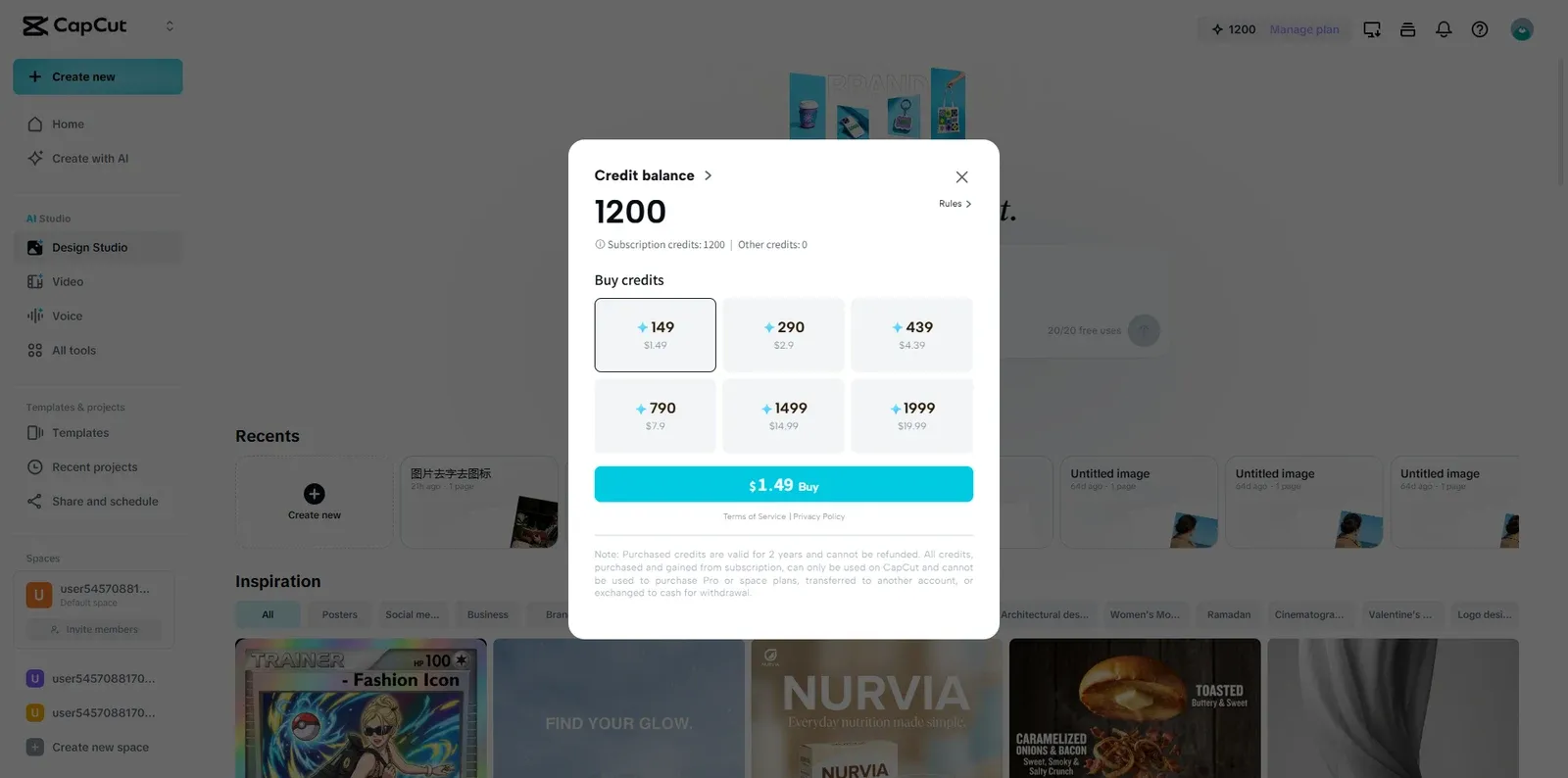
For Desktop, the purchase guide describes selecting Credits inside an AI feature and buying a pack there. The cross-device guidance instead says purchases redirect to Web. Either way, verify that the Web account is the one you intend to use before proceeding.
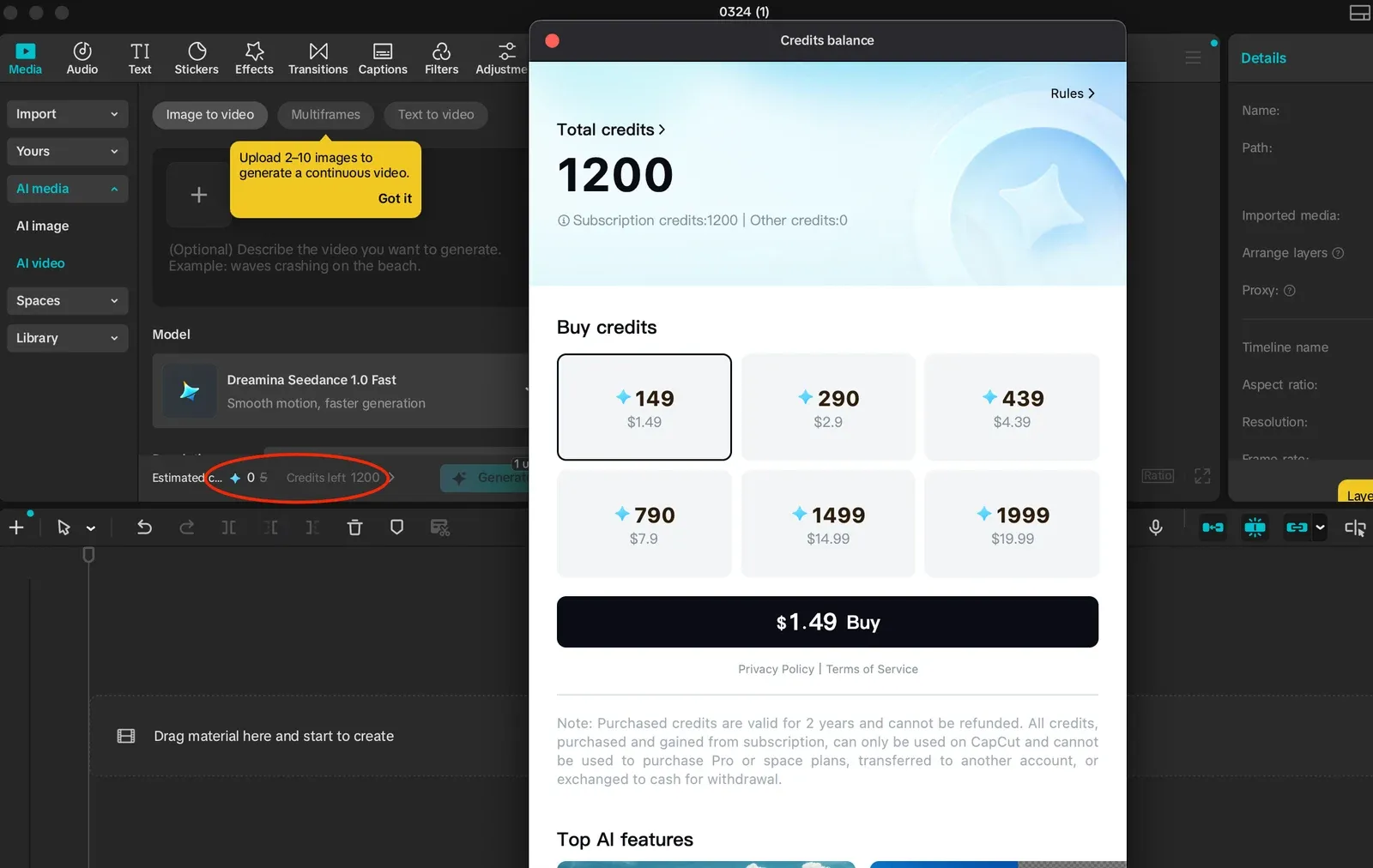
Mobile instructions conflict more sharply. The Credit Rules give a Me → Pro route for buying and checking credits. Usage Help describes an in-app purchase option after insufficient credits. Purchase Help says there is no mobile credit store or Credits section at all. The spending-order page even denies mobile credit consumption, while cross-device Help describes it. Don't treat an absent button as proof of a broken account, and don't install an unofficial app to obtain it.
Before paying anywhere, save the pack quantity, final currency total, account, expiry and refund terms. If the balance page doesn't show the information you need, ask support before buying more than you expect to use soon.
What happens when Pro ends?
Turning off renewal and reaching the end of a paid plan are different events. The Credit Rules say cancelling renewal leaves the current subscription-credit batch valid until the end of its subscription month; purchased and activity credits keep their own expiry rules. The monthly-versus-annual disagreement above still matters for annual accounts.
Once Pro ends, CapCut's post-expiry guidance says subscription credits expire, while unexpired purchased and activity credits remain. A remaining balance doesn't preserve Pro-only tool access. Use our Pro cancellation guide for the separate renewal process.
Should you exchange legacy Pro uses?
Only consider this if your account offers it. CapCut's legacy-use exchange guidance and Credit Rules describe an irreversible conversion: remaining Pro uses become subscription credits, and future months grant credits instead of uses.
Read the offered amount and expiry before accepting. The rules warn the new allowance may cover fewer operations than the old uses. This is a legacy migration, not a required setup step or a reason to change your subscription. We haven't performed an exchange.
Failed generation or missing credits: what to record
A failed job, an unsatisfactory completed result and a cash refund for a purchased pack are three different cases. The Credit Rules call purchased credits non-refundable. They don't establish whether every failed job's deduction is restored. The public sources checked here don't promise automatic restoration for every failure.
The Terms of Service preserve applicable mandatory consumer rights and distinguish regional terms. Don't apply a subscription refund window automatically to a credit pack, or assume a short Help answer resolves your payment dispute.
- Check the job state. Save the error or pending message before retrying. An unchanged balance isn't proof that no later charge can follow.
- Record the deduction. Keep the quoted cost, time, model/settings, job ID if available, and transaction entry or before-and-after balance. Don't repeat an expensive failed run blindly.
- Check account identity. Compare the account ID, original sign-in method, workspace and batch expiry. CapCut's sign-in guidance warns Google and email sign-in can create separate accounts despite using the same address.
- Ask support to investigate. Use in-app Help or the support email listed in the Credit Rules. Ask whether the charge is pending, final or restored. Don't send passwords or full card details.
A May 2026 r/CapCut report about failed AI Remix attempts describes deductions on some failures. It's one user's report, not a measured failure rate or refund policy. Your own transaction evidence is what support needs.
If the problem started after switching devices, use the same-account device setup guide. If payment is recorded but access is missing, follow Pro access troubleshooting before buying again.
What credits can't buy
The Credit Rules prohibit buying Pro or storage plans with credits, transferring them to another account or exchanging them for cash. Before buying a pack, confirm the intended tool is available and understand its charge. A large balance won't remove a tool's access restriction or guarantee a satisfactory AI result.
CapCut AI credits FAQ
How much is one CapCut AI credit worth?
Divide the final paid-pack total, including applicable tax, by the purchased credits to calculate one credit's cost. Multiply that result by a run's quoted credits only when calculating the run cost. Public Help examples conflict, so neither is a universal checkout price.
Does CapCut Pro include unlimited AI credits?
No. Eligible plans provide a limited allowance. CapCut's public pages disagree about equal versus plan-specific grants, so check the allowance shown for your account.
Can I buy credits without Pro?
Yes, the Credit Rules allow non-Pro members to purchase credits. That doesn't guarantee access to a Pro-only AI tool.
Do purchased CapCut credits expire?
The Credit Rules and credit-types Help say two years after purchase. Purchase Help says they don't expire. Keep the terms and expiry for your batch and ask support to clarify any disagreement before buying.
Do subscription credits roll over on an annual plan?
Don't assume they do. The Credit Rules describe monthly grants and expiry, while subscription-validity Help gives an annual-plan example lasting a year. Check each batch's grant and expiry dates.
Can I buy credits in the mobile app?
CapCut's public instructions disagree. The Credit Rules and usage Help describe mobile routes, while purchase Help denies a mobile store. Use only the official controls available to your account; Web is the more consistently documented fallback.
Can I get credits back after a failed generation?
The public sources checked here don't guarantee automatic restoration for every failed job. Save the error, quote, job ID if available and transaction evidence, then ask support whether the deduction is pending, final or restored.
Why is my credit balance different on another device?
Check the account ID, original login method, workspace and expiry before paying again. CapCut says balances are account-based; different sign-in methods can create different accounts even when the email address matches.