

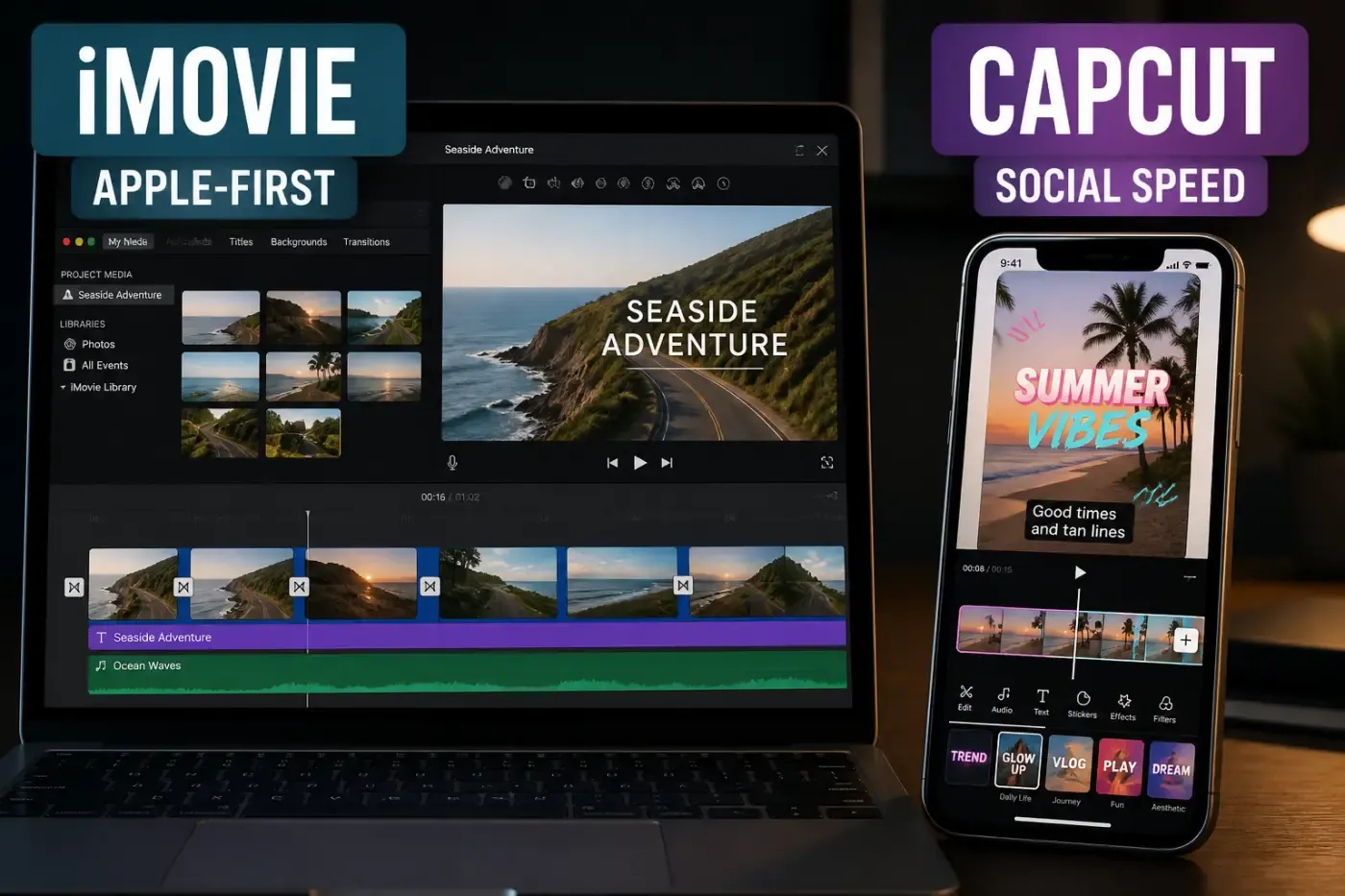
iMovie is a good CapCut alternative if you use an iPhone, iPad or Mac and want a clean, free editor with no subscription meter. It is deliberately calmer than CapCut: trim a sequence, add a title, record narration, choose music and export. Magic Movie and Storyboards help beginners get moving, while a regular Movie project gives you a more controlled timeline. CapCut is the better fit for Android, Windows, AI tools, animated captions, trend templates and daily vertical posts.
This iMovie review was rechecked on September 4, 2026 against Apple's live iPhone/iPad and Mac store listings, current iMovie product and support pages, the observable review/comparison results and a recent iMovie community discussion. The decision goes beyond “free versus paid”: the two apps have different version numbers, current OS gates are strict, 4K and 60 fps use several distinct export paths, and an editable mobile-to-Mac handoff has theme, HDR and version caveats.
iMovie Review Facts at a Glance
| Review fact | Current answer |
|---|---|
| Core product | Apple's free, beginner-friendly video editor for iPhone, iPad and Mac, with manual Movie projects plus Magic Movie and Storyboards. |
| Price | Free in the current Apple App Store listings; there is no iMovie subscription or AI-credit meter. |
| Platform gate | Apple devices only. The live iOS/iPadOS listing requires iOS 17.6 or iPadOS 17.6; the Mac listing requires macOS 15.6 or later. |
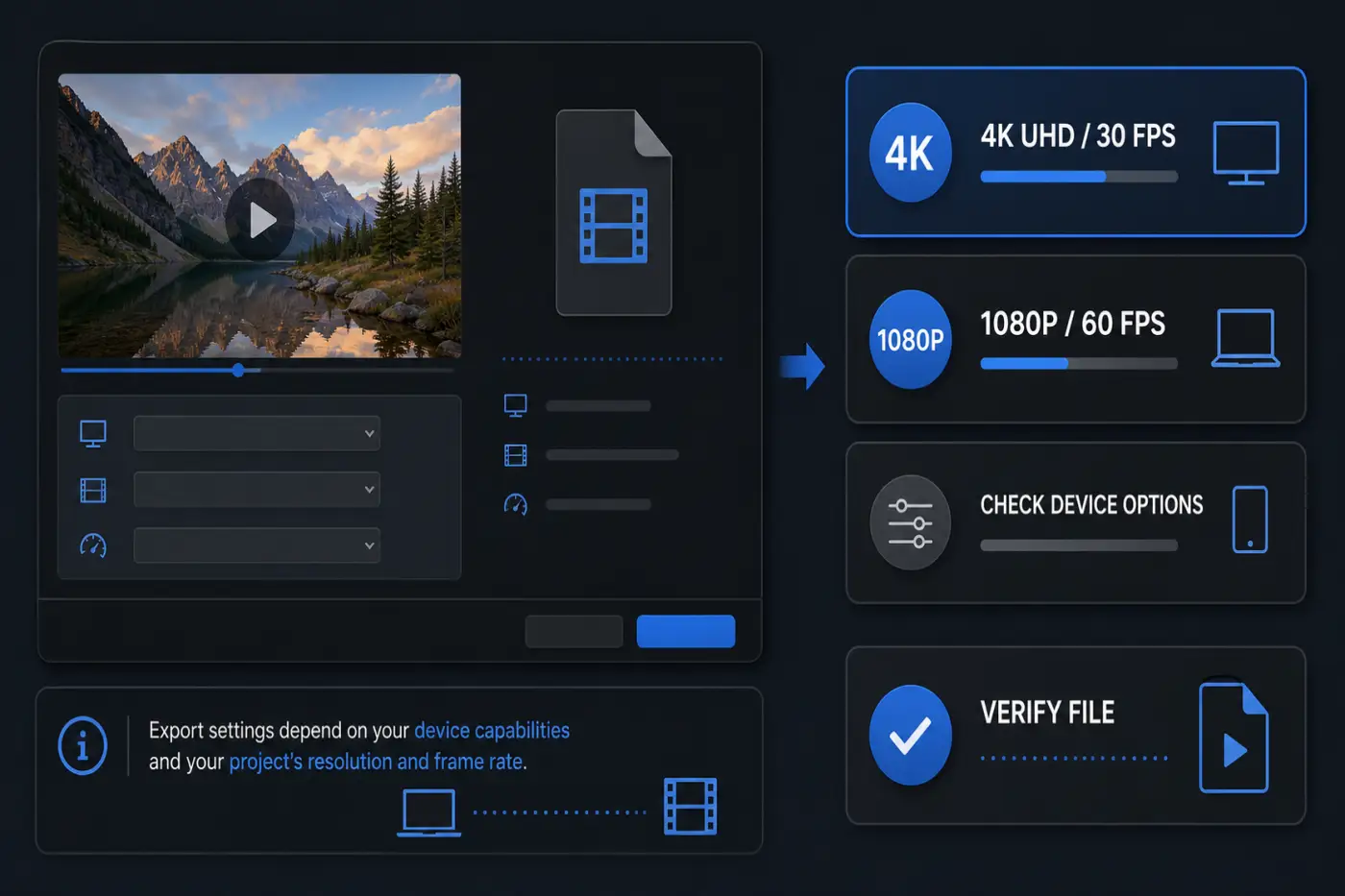
| 4K export | Apple's support guide documents 3840×2160 4K UHD export at 30 fps when the project is 4K. |
| 60 fps export | Apple documents 1080p60 export with a separate iOS/iPadOS setting and a Mac 1080p 60 option; 4K60 is device/version/export-option dependent. |
| Guided modes | Magic Movie assembles clips, Storyboards provide a shot list and Movie projects give the most manual timeline control. |
| Handoff | Projects can move between Apple devices through AirDrop, Files/iCloud Drive or a Mac import; an exported video is safer for non-Apple editors. |
| Best fit | Family films, school projects, simple YouTube videos, clean travel edits and Apple users who value a short learning curve over social effects. |
Quick Verdict: iMovie Is the Calm Apple-first Choice
Choose iMovie when your footage already lives in Photos, your editor is an iPhone, iPad or Mac, and the finished video needs to look intentional without a long setup. Apple gives you a straightforward timeline, clean titles, transitions, filters, voiceover, picture-in-picture, green screen and a useful library of soundtracks and effects. You can start with a guided project and move to a manual one when you need more control.
Choose CapCut when the actual brief says “make a Reel or Short that feels current.” CapCut brings animated captions, templates, beat-led effects, AI helpers and broader device coverage to the front of the workflow. Our CapCut alternatives guide covers the wider shortlist, but iMovie deserves its own review because its strength is the absence of friction, pricing surprises and watermarks rather than a bigger tool count.
There is one non-negotiable question: do you own an up-to-date Apple device? The current iPhone/iPad listing requires iOS or iPadOS 17.6, while the Mac listing requires macOS 15.6. If your phone, tablet or Mac can't install the current app, “free” doesn't help until you find a compatible earlier build. Verify compatibility in the App Store before planning a project around it.
What iMovie Is in 2026
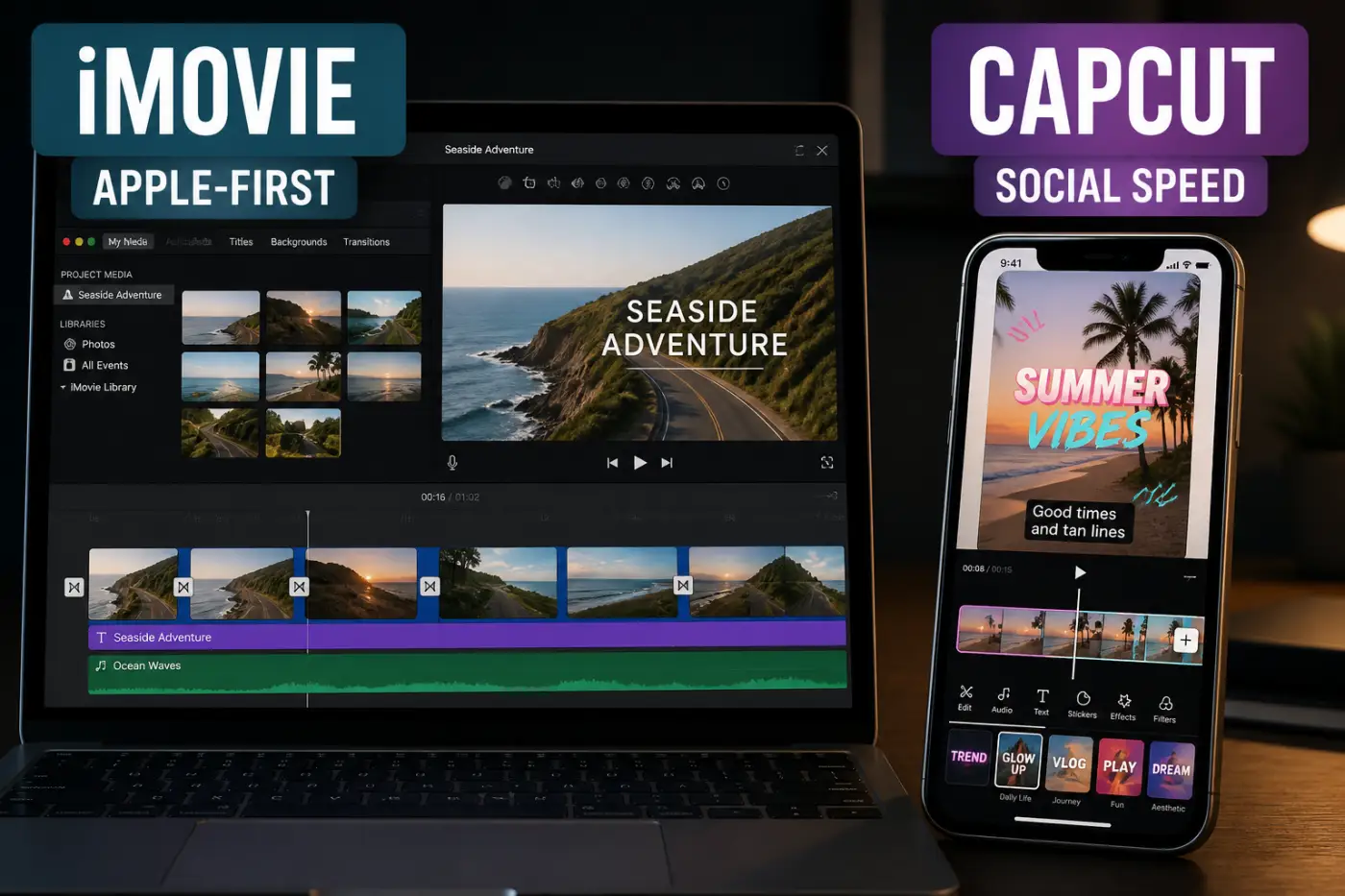
Apple's current iMovie product page presents one editor across iPhone, iPad and Mac, but the interfaces are not identical. On mobile, touch controls and guided projects make it easy to select footage and tell a short story. On Mac, the browser, viewer and timeline give you a wider editing surface, keyboard shortcuts and a more comfortable place to organize a longer sequence.
The live store history shows iMovie 3.0.5 for iPhone and iPad and iMovie 10.4.4 for Mac on September 4, 2026. Those labels are more useful than an old blog post saying “the latest iMovie.” Apple updates the apps separately, so check the store on the device where you plan to edit. A project made with a newer mobile build may not import cleanly into an older Mac build.
iMovie is not Final Cut Pro with a free button. It is a creator editor designed around a primary story, connected clips and accessible controls. You can build a polished video, but the workflow intentionally avoids the deep color, audio routing, plugin ecosystem and multi-editor collaboration of a professional NLE. That narrower focus is exactly why it feels manageable to a new editor.
Free Does Not Mean Cross-platform
iMovie is free in Apple's current App Store listings, and there is no plan switch, watermark or AI-credit allowance to calculate. That makes the first project refreshingly simple: install the app, allow access to the Photos and media libraries, import footage and start cutting. It also makes the platform boundary more important than the price.
There's no official Android or Windows iMovie app. A friend who receives an iMovie project can't open the editable timeline in CapCut, Premiere or a Windows-only editor. Export a finished MOV or MP4 when the recipient only needs to watch or publish the video; export the iMovie project when the next editor also uses a compatible Apple workflow.
The current Mac listing requires macOS 15.6 or later, 4 GB memory and 3.5 GB available space. The iPhone/iPad listing requires iOS 17.6 or later or iPadOS 17.6 or later. Apple may offer an older compatible version through an existing purchase history, but that is a device-and-account path, not a universal promise. Check the store before buying hardware or moving a library.
Magic Movie, Storyboards or Movie Project?
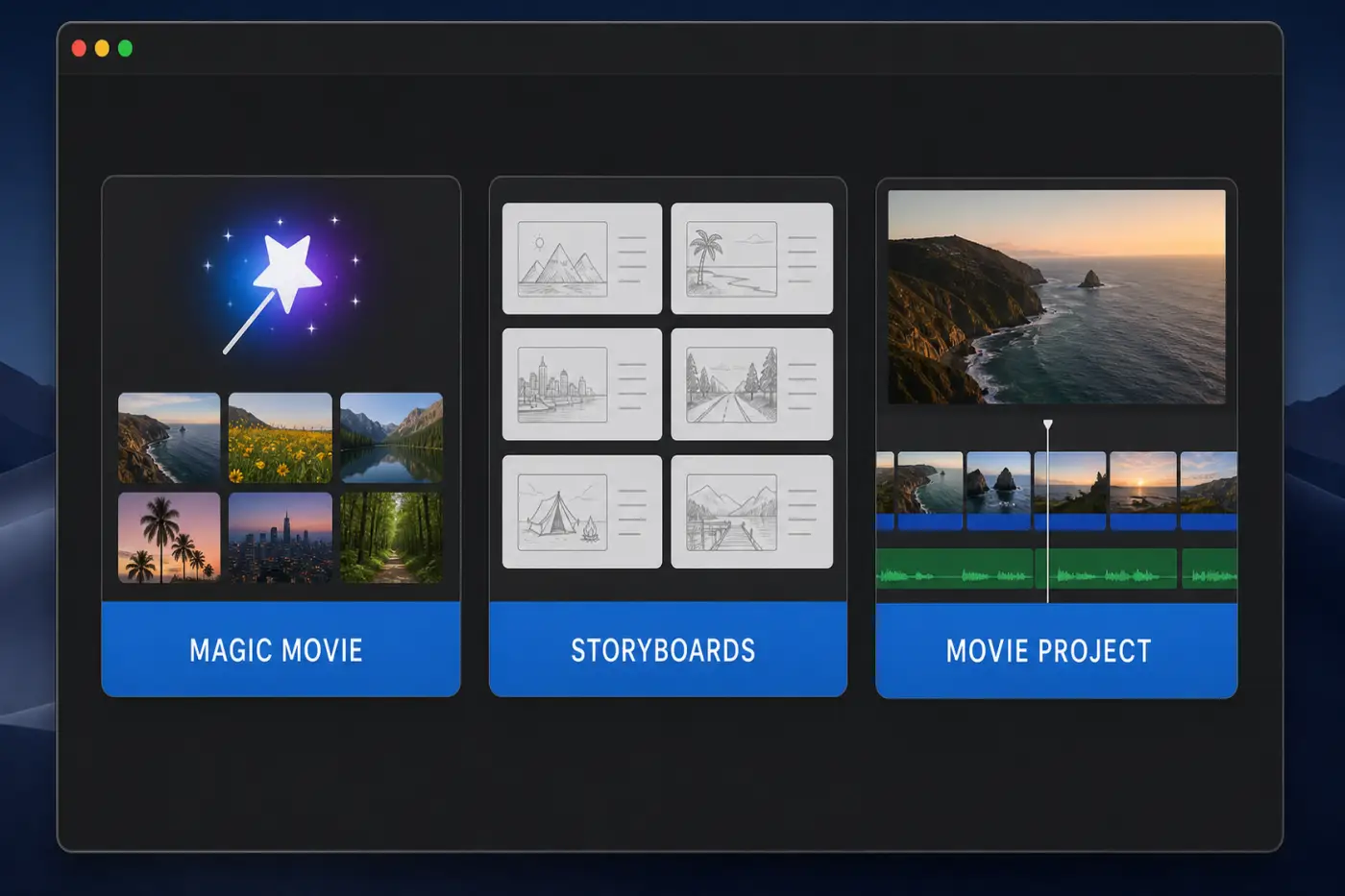
Apple's iMovie guide describes three project modes on iPhone and iPad:
- Magic Movie selects clips and photos, then builds a first cut with a soundtrack, transitions and a style. You can rearrange, remove and edit the clips afterward.
- Storyboard gives you a shot list for a type of video such as a product review, cooking tutorial or Q&A. It suggests the kind of shot to capture and supplies matching titles, transitions and music.
- Movie starts with a manual project. You choose the order, trim and split clips, add overlays, titles and audio, and make the story decisions yourself.
Magic Movie is the closest iMovie gets to a one-tap social assistant, but it is not CapCut's AI generation layer. It works from your own media and gives you a structured draft. Storyboards are more valuable for a beginner who doesn't yet know what shots a tutorial needs. A regular Movie project is the right choice when you already have a script, a sequence or a long interview to shape.
The current iPhone/iPad listing lists 20 Storyboards, 14 trailer templates, 8 themes, 13 Apple-designed filters and 11 animated title styles. These are dated mobile counts, not a promise that the Mac catalog is identical or that Apple will never change them. They still communicate the design philosophy: a curated set of coherent choices rather than the large template marketplace that makes CapCut feel current.
Timeline and Learning Curve
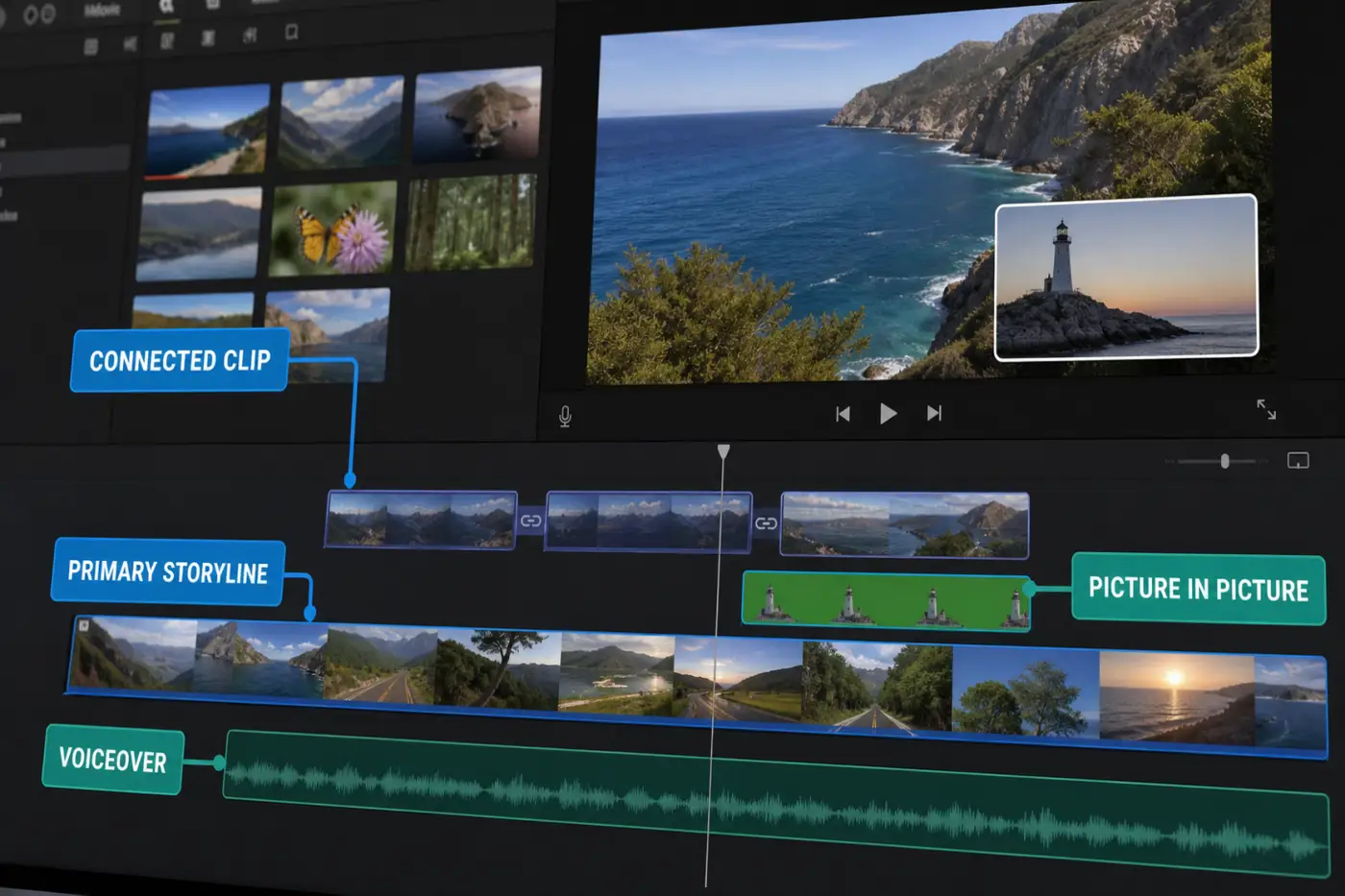
On Mac, you build a movie by dragging clips from the browser into a primary timeline. You can trim edges, split clips, insert a selected range, reorder shots, adjust speed and use the precision editor when an edit point needs more care. Connected clips sit above the primary storyline for cutaways, picture-in-picture, split screen and green screen. The result is capable enough for a clean YouTube essay or travel film without exposing every professional control at once.
On iPhone and iPad, a touch-first Movie project gives you the same basic decisions in a smaller space. A keyboard and trackpad can make an iPad workflow more accurate, but the app is still designed around selecting, dragging and tapping rather than around a full desktop shortcut map. That is a feature for casual editing and a limitation for someone who wants a fast, dense professional timeline.
iMovie's restraint helps with pacing: you are more likely to ask whether a clip belongs in the story than to spend ten minutes auditioning a new effect. The ceiling becomes obvious when a project needs many simultaneous layers, detailed color work, transcript editing or a large audio mix. Compare the DaVinci Resolve review when you want a deeper desktop NLE, or the LumaFusion review when you want a more capable paid timeline on iPad.
Titles, Captions and Vertical Social Video
iMovie has animated title styles, title placement controls, filters, backgrounds and readable transitions. That is enough for an opening card, chapter label, lower-third or end screen. It is not a transcript editor: there is no CapCut-style auto-caption workflow that turns speech into a timed, animated text layer with one tap.
If your video needs captions for accessibility, you have two practical options. Add titles manually for a short clip, or export the clean video and use a dedicated caption tool. Our CapCut auto-captions guide covers the faster transcript-to-caption path. With iMovie, proofread the final captions in the target app rather than assuming a title treatment has the same safe area on every screen.
Vertical video is another decision point. iMovie can work with portrait footage, but its project and export flow is not organized around the 9:16 template/caption/beat workflow that dominates Reels and Shorts. Test a short portrait project before cutting a long one; check whether the crop, title position and exported dimensions match the platform. If you need exact social ratios and a library of vertical presets, CapCut is the less awkward choice.
Don't rotate a finished file repeatedly just to force a ratio. Keep the clean landscape or portrait master, then make platform versions in a tool that exposes the intended canvas. This avoids black bars, sideways titles and a final export that looks fine in Photos but wrong inside a social app.
Audio, Voiceover and Music Rights
iMovie is comfortable with the audio that accompanies a personal film. You can add built-in sound effects, background music, audio from your Music library, a clip's original sound and a recorded voiceover. The Mac guide places background music in its own area so it can be trimmed independently of the main video; a voiceover appears as an attached audio clip.
Separate Apple's bundled audio from songs you bring in. Apple says the built-in iMovie soundtracks and sound effects are free to use in iMovie projects. That statement does not clear a commercial song from your Music library or give you the right to redistribute an Apple audio asset by itself. For public or client work, keep the finished video within the allowed project use and use outside music only when its license covers the destination.
iMovie's audio controls are deliberately basic: volume, fades, ducking and a few effects rather than a full mixing console. Record narration in a quiet room, keep speech above the music and listen once on headphones and once on the device that will play the final video. If the brief calls for vocal isolation, pitch correction, multi-bus mixing or a large sound library, plan a handoff to another editor.
4K, 60 fps and Export Reality
iMovie can export a high-quality file, but the resolution and frame-rate rules are easy to collapse into one misleading “4K60” label. Apple's current 4K and 60 fps guide says that on Mac the first clip added to the timeline determines the project format. Add a 4K clip first for a 4K project; add a 60 fps clip first for a 60 fps project.
Apple's Mac guide documents 4K at 3840×2160 and 30 fps. Its 60 fps sharing instructions use 1920×1080, with an “Enable 60 fps export” setting on iPhone/iPad and a “1080p 60” choice on Mac. The current iPhone/iPad store listing separately advertises saving up to 4K at 60 fps on compatible devices. Treat that mobile 4K60 claim as conditional: the source media, supported device, app build and live Options screen all need to expose the path.
On iPhone or iPad, you can save to Photos, Files, iCloud Drive, AirDrop or an enabled third-party storage service. On Mac, choose File in the Share window and set the resolution, quality and compression. Apple also provides optimized sharing for YouTube and Facebook, but you still upload the resulting file yourself.
MP4 needs special care because Apple documents it as a separate compatibility route. The current Share or export your iMovie video page says that an iPhone/iPad project must first be imported into iMovie on Mac for its specifically named MP4 conversion, then shows Medium or Low quality at 720 or 540. Do not read that narrow container-conversion instruction as the limit for every mobile share: Save Video and Share Video have their own resolution and frame-rate options. Whichever path you use, inspect the exported file's container, dimensions, frame rate, audio and captions before publishing.
Project Handoff: AirDrop, iCloud Drive and Mac
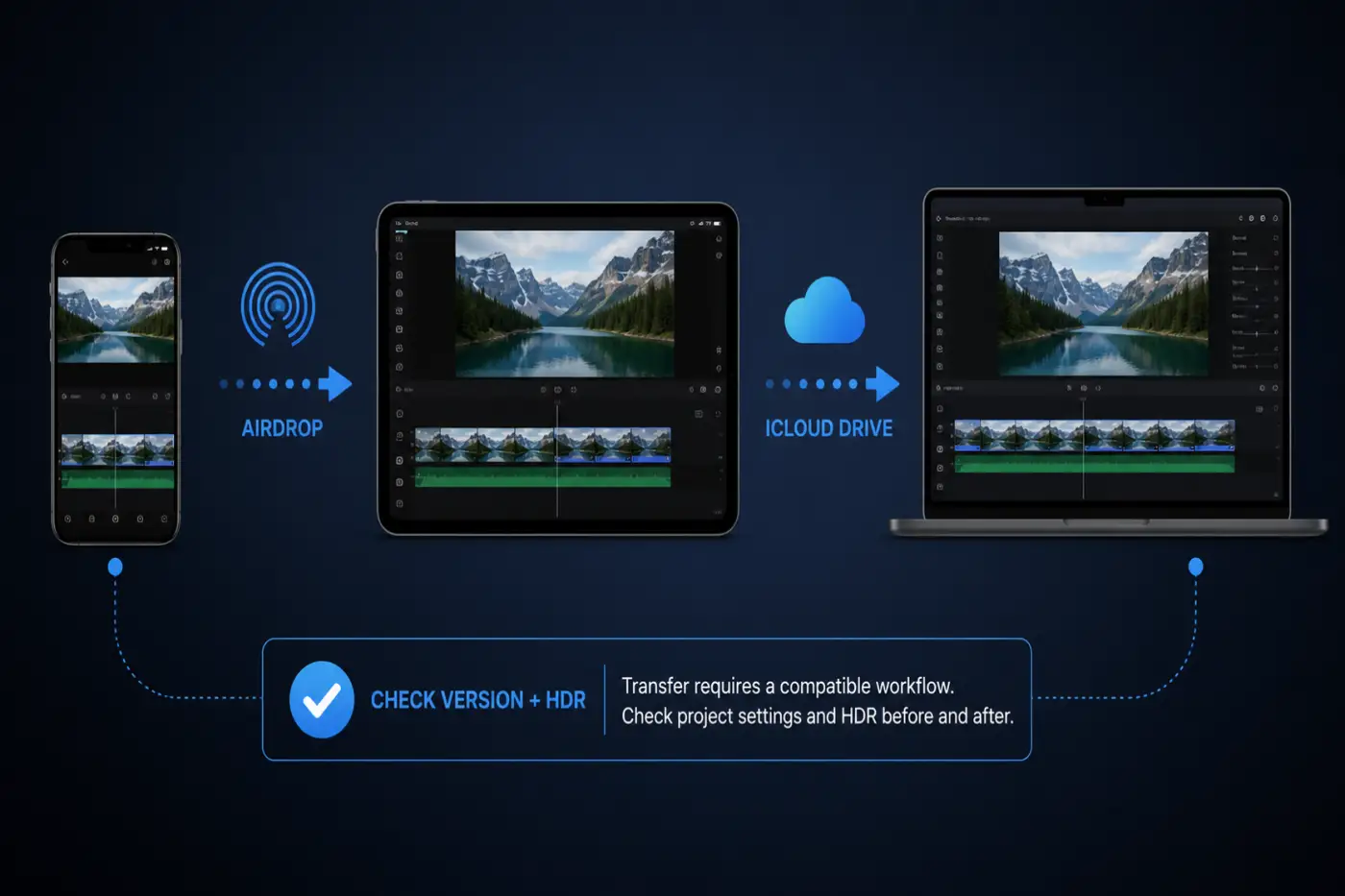
One of iMovie's best advantages over a random free editor is its Apple project handoff. Apple's Export Project guide says the project and its used media are saved together and can move through AirDrop, Files/iCloud Drive, Mail or Messages. On Mac, use File → Import iMovie iOS Projects to continue editing rather than starting from a rendered video.
The handoff is not live cloud collaboration. Apple warns that a mobile theme missing on the Mac falls back to the default Mac theme. HDR media is tone-mapped to SDR for display after import, while the source media in the library remains unchanged. Apple also notes that a project from a newer iPhone/iPad build can fail to import into an older Mac build. Transfer a short copy and reopen it before trusting this route with the only version of a project.
Choose the handoff deliberately:
- Editable Apple project: use Export Project, AirDrop or iCloud Drive, and confirm the receiving device runs a compatible iMovie build.
- Finished video: export a MOV or MP4 and give the other editor a file that doesn't require iMovie.
- Non-Apple collaborator: send a clean rendered master plus a note about the frame size, frame rate, music license and captions. They won't receive an editable iMovie timeline in CapCut or Windows software.
Cinematic Mode, ProRes and Apple Media
iMovie becomes more useful when your footage already comes from Apple devices. Apple documents editing Cinematic mode video, changing focus points and adjusting the depth-of-field effect on supported devices. The product page also lists ProRes import and Apple ProRAW stills. These features make a phone-shot family film or product demo feel more controlled without asking a beginner to understand a professional camera pipeline.
Compatibility still matters. The App Store listing attaches device requirements to Cinematic mode and 4K/60 workflows, and the Mac listing has its own operating-system gate. Start with a short sample from the actual iPhone or camera, import it into the target iMovie build and check focus controls, HDR appearance and export options before committing to a long edit.
CapCut can accept many of the same media types, but its value is elsewhere: auto captions, templates, effects and AI-assisted social revisions. iMovie is the better choice when the clean image and the Apple capture pipeline are the main story; CapCut is the better choice when the video has to be repackaged several times for social platforms.
Performance, Storage and Reliability
iMovie is generally comfortable on a supported Mac, iPhone or iPad, but “free” doesn't mean that a 4K library is free of storage pressure. iMovie projects reference or package media, and exported masters can be large. Keep enough local space for the source clips, render and final file; the Mac App Store listing itself calls for 3.5 GB available space before your footage is counted.
When an edit feels slow, test a short section rather than blaming the whole application. Large Photos libraries, multiple 4K clips, HDR, background transfers and an almost-full device can make the project browser or export feel heavy. Keep original media safe, avoid deleting source clips until the final export is checked and give a mobile project time to finish copying before closing the app.
A current r/iMovie feature-request discussion asks for a caption generator, selective blur, a Shorts editor, livelier text and more picture-in-picture freedom. That is directional evidence, not proof that every user needs those tools. It does, however, match the practical boundary in this comparison: iMovie is comfortable when the story is simple; CapCut or a deeper editor becomes attractive when presentation and layering are the job.
iMovie vs CapCut: Feature Comparison
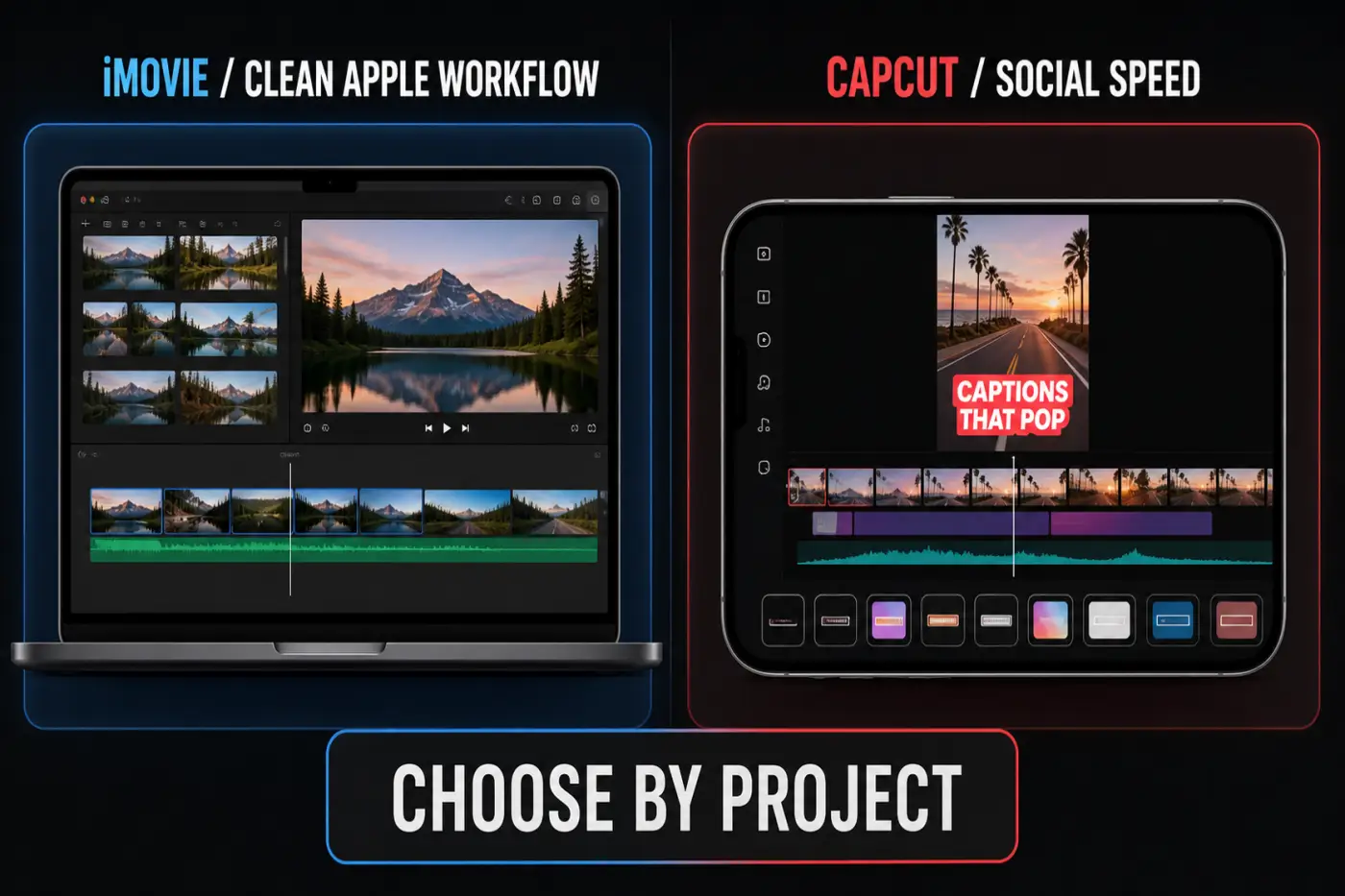
Both apps can turn phone footage into a finished video. iMovie starts with the Apple library, a curated style and a simple timeline. CapCut starts with social formats, templates, captions and AI tools. Use this table as a workflow decision, not as a claim that one app wins every row.
| Decision factor | iMovie | CapCut |
|---|---|---|
| Price | Free Apple app with no iMovie subscription or watermark | Free and paid paths vary by platform, region, feature and account |
| Platforms | iPhone, iPad and Mac only; current OS requirements apply | Mobile, web and desktop coverage across more devices |
| Starting modes | Magic Movie, Storyboards or manual Movie project | Blank timeline, templates, auto tools and social presets |
| Timeline | Clear primary storyline with connected clips, overlays and audio | Effect-heavy social timeline with keyframes, masks, templates and shortcuts |
| Captions | Manual titles and subtitle-style text; no comparable built-in auto-caption workflow | Auto captions, animated text, translation and social caption styles |
| AI | Guided Magic Movie assembly rather than a credit-metered generative AI suite | Wide creator-focused AI toolset; what's available shifts with version, region and plan |
| Export | Apple documents 4K UHD 30 fps and 1080p60 paths; verify device/version options | Resolution, frame rate, watermark and plan rules vary; check the export screen |
| Handoff | Editable project via AirDrop/iCloud Drive between Apple devices; HDR/version caveats | Cloud/account handoff varies; cross-platform publishing is easier |
| Music | Built-in effects/soundtracks plus library audio; rights still matter | Large social music/effect ecosystem; asset and commercial rights still need checking |
| Social ratios | Not built around trend templates or an exact 9:16 production loop | Vertical templates, effects, captions and platform-led workflows |
| Best fit | Apple users, family films, school projects, clean YouTube and travel edits | Shorts/Reels/TikTok, daily social publishing and cross-device teams |
Choose iMovie If You...
- already use an iPhone, iPad or Mac and want a free editor with no watermark;
- make family films, school projects, travel videos, simple tutorials or clean YouTube edits;
- want Magic Movie or Storyboards to give a beginner a sensible starting structure;
- prefer a curated set of titles, transitions, filters and soundtracks to an endless template marketplace;
- need an editable project handoff through AirDrop or iCloud Drive inside Apple's ecosystem;
- can verify your device's current OS, 4K/60 export path and available storage before a large project;
- care more about a readable story and restrained effects than AI-generated social variations.
Stay With CapCut If You...
- need Android, Windows, web access or a workflow that is not tied to Apple hardware;
- publish daily vertical videos and need captions, templates, beat maps, stickers or rapid effects;
- want auto captions, translation, AI cleanup or generative tools in the same editing surface;
- need exact social canvas controls and several Reels/Shorts versions from one master;
- collaborate with people who won't open an iMovie project on an Apple device;
- expect a deep audio, color, multi-layer or plugin workflow beyond iMovie's creator scope;
- prefer an account-based web/desktop project over a local Apple library and file handoff.
A Practical iMovie and CapCut Hybrid Workflow
Use iMovie for the clean master when the source is on an iPhone or iPad. Build the story, trim the interview, add a restrained title and voiceover, check the 4K/60 export path, then save a high-quality master. Keep the editable iMovie project for later revisions and a rendered MOV/MP4 for collaborators who don't use Apple devices.
Use CapCut for the social finishing pass. Import the clean master, choose the intended 9:16 or square canvas, generate and proof captions, add a platform-appropriate effect and export a version for each destination. Our CapCut export settings guide covers the final-file checks; don't re-encode the same clip repeatedly when one clean master can feed every version.
Flip the order for a quick social idea: find the hook and trend timing in CapCut, then use iMovie on a Mac for a calmer longer edit or family-safe version. Treat the handoff as a file with documented dimensions, frame rate, audio and music rights rather than as a promise that the iMovie project will open in every app.
Frequently Asked Questions
Is iMovie really free?
Yes. The current iPhone/iPad and Mac App Store listings show iMovie as a free Apple app with no iMovie subscription tier or export watermark. The catch is hardware and operating-system compatibility: current listings require iOS/iPadOS 17.6 or later on mobile and macOS 15.6 or later on Mac.
Is iMovie better than CapCut?
iMovie is better for an Apple user who wants a clean, restrained timeline, simple titles, voiceover and a free master without a subscription meter. CapCut is better for cross-platform work, auto captions, templates, AI tools and daily vertical publishing. The winner follows the workflow, not the feature count.
Can iMovie export 4K?
Yes. Apple's support guide documents 4K UHD export at 3840×2160 and 30 fps when the project is 4K. Add a 4K clip first on Mac because the first clip determines the project format. Check the export menu on your device before assuming every source or older build exposes the same choices.
Can iMovie export 60 fps or 4K60?
Apple documents a 1080p60 path: enable 60 fps export on iPhone/iPad or choose 1080p 60 on Mac. The App Store also advertises up to 4K at 60 fps on compatible devices, so 4K60 should be treated as device-, version- and export-option dependent. Verify the actual Options/Resolution menu for the project.
Can I move an iMovie project from iPhone to Mac?
Yes, export the editable project through AirDrop, Files or iCloud Drive and import it into iMovie on Mac. Apple warns about missing mobile themes, HDR tone mapping to SDR for display and possible errors when the mobile build is newer than the Mac build. A rendered MOV/MP4 is the safer handoff to a non-Apple editor.
Does iMovie have auto captions?
iMovie has titles and text treatments, but it is not a transcript-first auto-caption editor like CapCut. For a short clip you can add titles manually; for a long talking video, export a clean master and use a dedicated caption workflow. Proofread names, numbers and timing before publishing.
Final Verdict: Choose iMovie for Apple-first Simplicity
iMovie is still one of the best free starting points for Apple users who want a clean story, a short learning curve and no watermark. It loses to CapCut when the job is a caption-heavy vertical content pipeline, a cross-platform team or an AI-assisted social edit. Start with a five-minute project from your real footage, check the device requirements and export options, then choose the app whose limitations fit the video you make.