

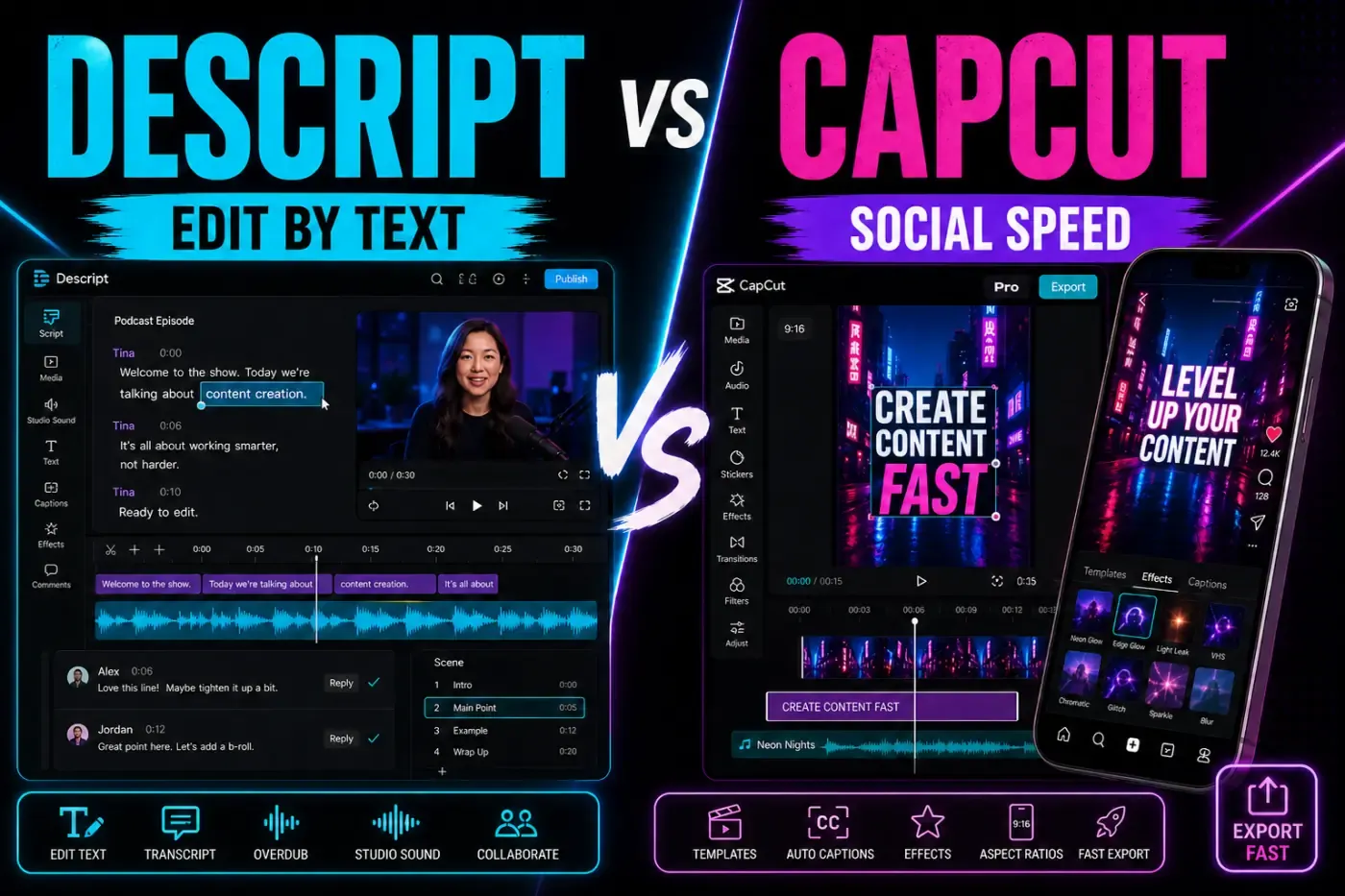
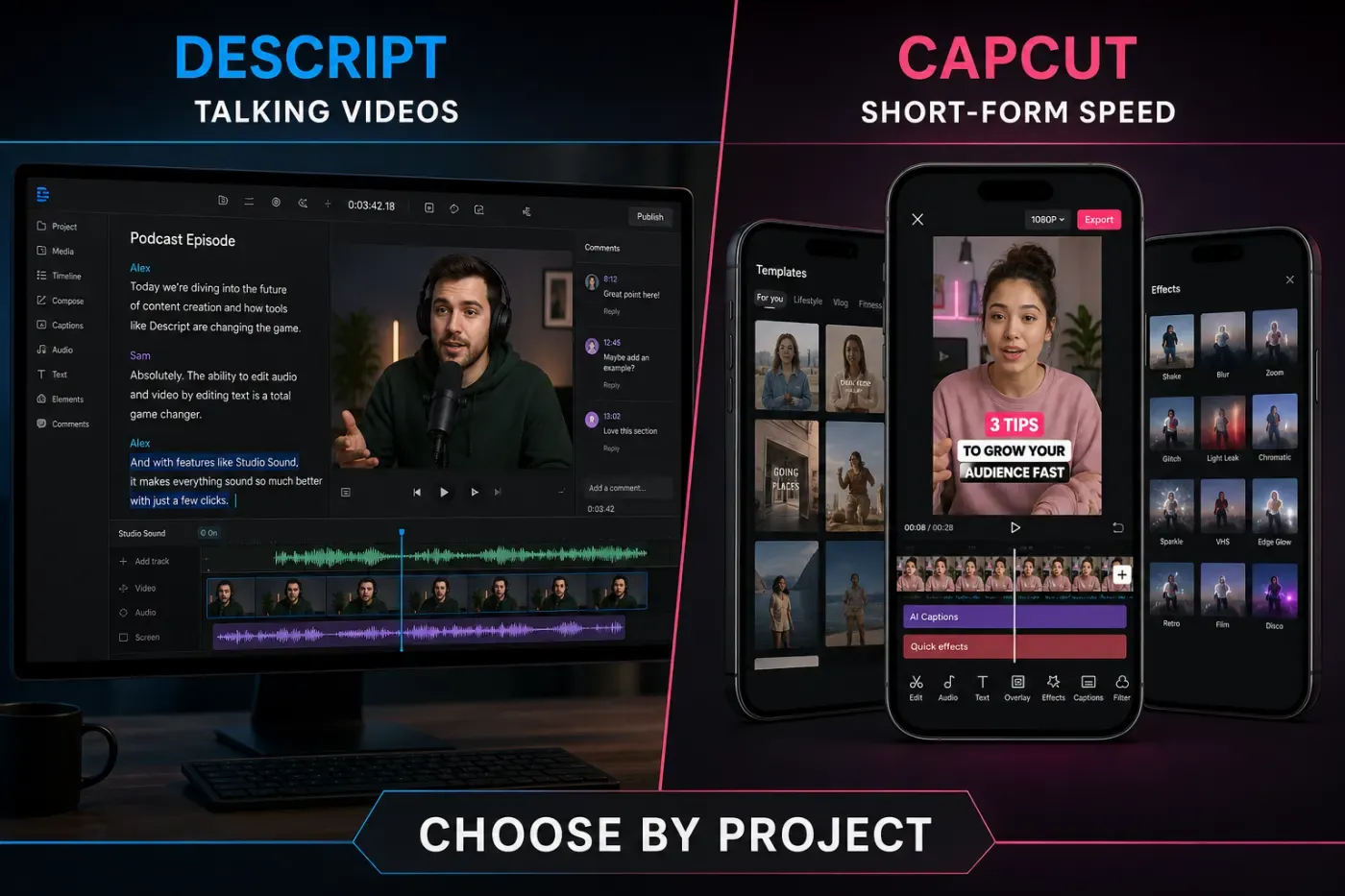
Short answer: Descript is a better CapCut alternative when your videos start as conversations, screen recordings, lessons or podcasts and the fastest edit is the one you can make by changing a transcript. CapCut is still the better fit for phone-first social edits, animated captions, templates and trend effects. Descript saves time on the story edit; it doesn't replace CapCut’s social packaging.
This review covers the current Descript desktop and browser workflow: transcription, text-based cuts, AI audio, scenes, captions, collaboration, export and the media-minute/AI-credit model. The facts were rechecked on September 4, 2026 against Descript's live pricing matrix and current help pages. Prices are a US snapshot, so confirm the total for your country, billing cycle and tax before paying.
Facts at a Glance
| Question | Current answer |
|---|---|
| Best fit | Talking-head videos, podcasts, interviews, screen recordings, courses and teams reviewing a cut in a browser. |
| Editing model | Edit the transcript and Descript cuts the linked audio/video non-destructively; scenes and a timeline handle layouts and timing. |
| Free plan | $0 with 60 media minutes per month, 100 one-time AI credits and 720p video export with a Descript watermark. |
| Paid snapshot | Hobbyist $16 with annual billing/$24 monthly per person; Creator $24/$35; Business $50/$65. US pricing checked September 4, 2026. |
| Usage model | Plans include media hours and AI credits. Uploads/recordings consume media minutes; Underlord and enhancement tools consume AI credits. |
| Platforms | Desktop app and supported Chromium browsers. Mobile editing is not officially offered; a phone can upload media. |
| Export | Local video, audio, GIF, text and subtitle export plus shareable web pages and publishing connections; plan controls resolution and watermark boundaries. |
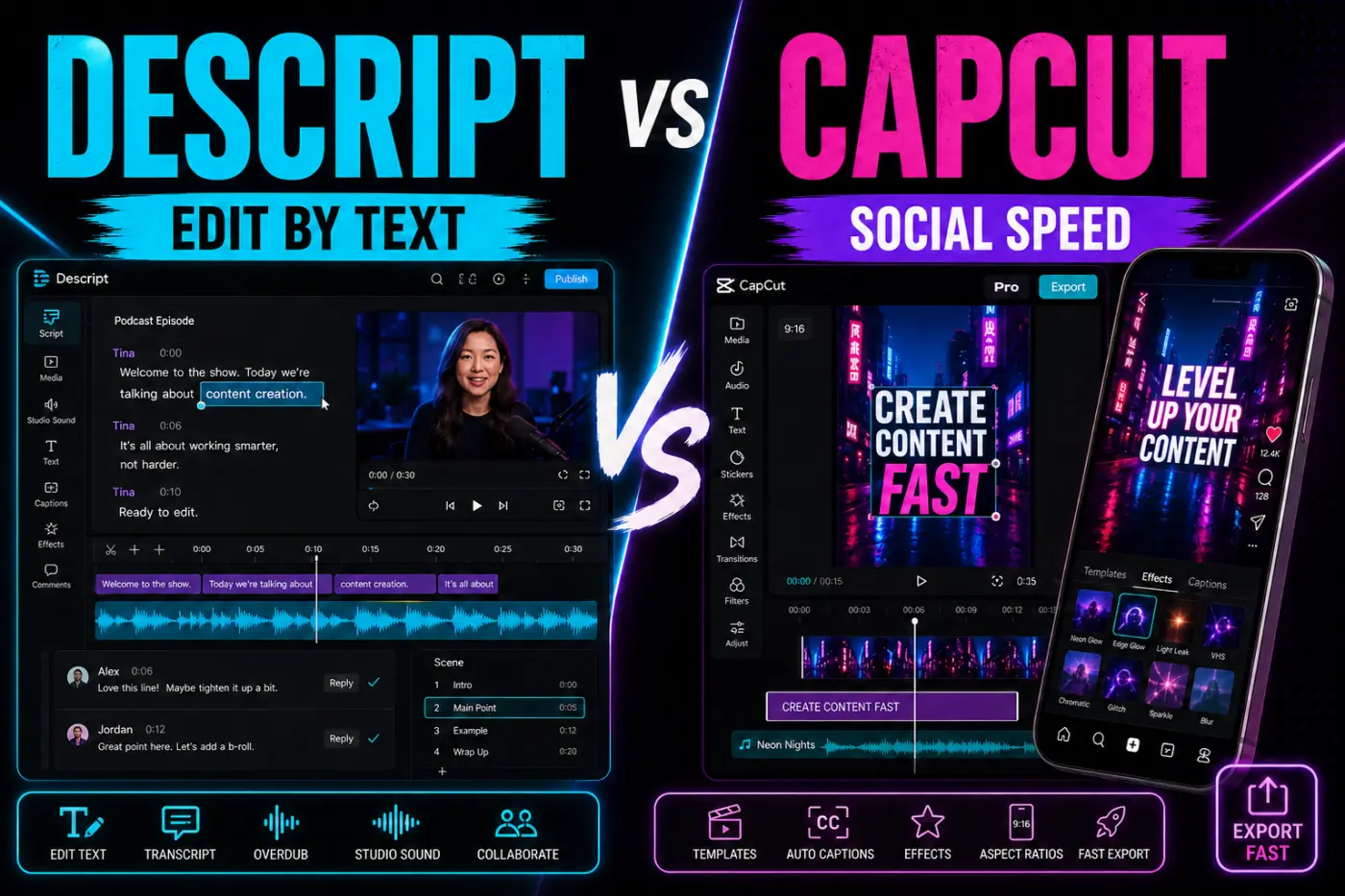
Quick Verdict: Descript Wins the Talking-Video Edit
Descript’s strongest idea is also its clearest test: if you can identify the words you want to remove, you can remove the matching video without scrubbing a timeline for every pause. The transcript becomes a practical edit list. Delete a sentence, tighten a paragraph, move a phrase or find every mention of a topic, then check the cut in the preview. For a 30-minute interview, that is a different kind of speed from a template or a one-tap effect.
That advantage has a shape. Descript is unusually good at dialogue, narration and screen recordings. It is comfortable with a producer who leaves comments on a line of the script, a guest who reviews a web link, or a teacher who wants to turn one recording into several lessons. It is less convincing when the job is to make a highly animated vertical Short from a phone, match a trending caption style, or browse a large library of social templates. CapCut’s mobile and web workflow is built for those moments; our CapCut alternatives guide maps the wider field.
My verdict is conditional rather than absolute: choose Descript when the spoken content is the raw material and revision is the bottleneck. Keep CapCut when publishing speed, kinetic captions and trend-led packaging matter more than transcript control. Many creators can use both, with Descript as the story edit and CapCut as the final social version.
What Descript Is in 2026
Descript is a text-based video editor with desktop and browser versions. You import or record audio/video, the service creates a transcript, and the transcript sits beside a preview and timeline. The current product is more than a transcription window: Descript’s getting-started guide describes recording, Rooms, imported media, AI Speakers and scenes for split-screen, picture-in-picture, title cards and outros.
The difference from a conventional NLE is not that the timeline disappears. It remains useful for timing, music, B-roll and layout. The difference is that the first rough cut can be made in words. A producer can read a transcript, remove a repeated answer and leave a comment without learning every trim tool. A solo creator can turn one podcast recording into a clean long-form cut, a short excerpt and a written transcript before touching a caption preset.
There is a cloud-shaped workflow underneath. Media is uploaded or recorded, transcription and several AI operations are processed online, and projects can be opened in a browser. That makes review and handoff convenient, but it also makes internet access, account permissions, cloud storage and usage limits part of the product decision. Treat Descript as a connected desktop/web editor, not as a completely offline phone app.
The “Edit Like a Doc” Workflow
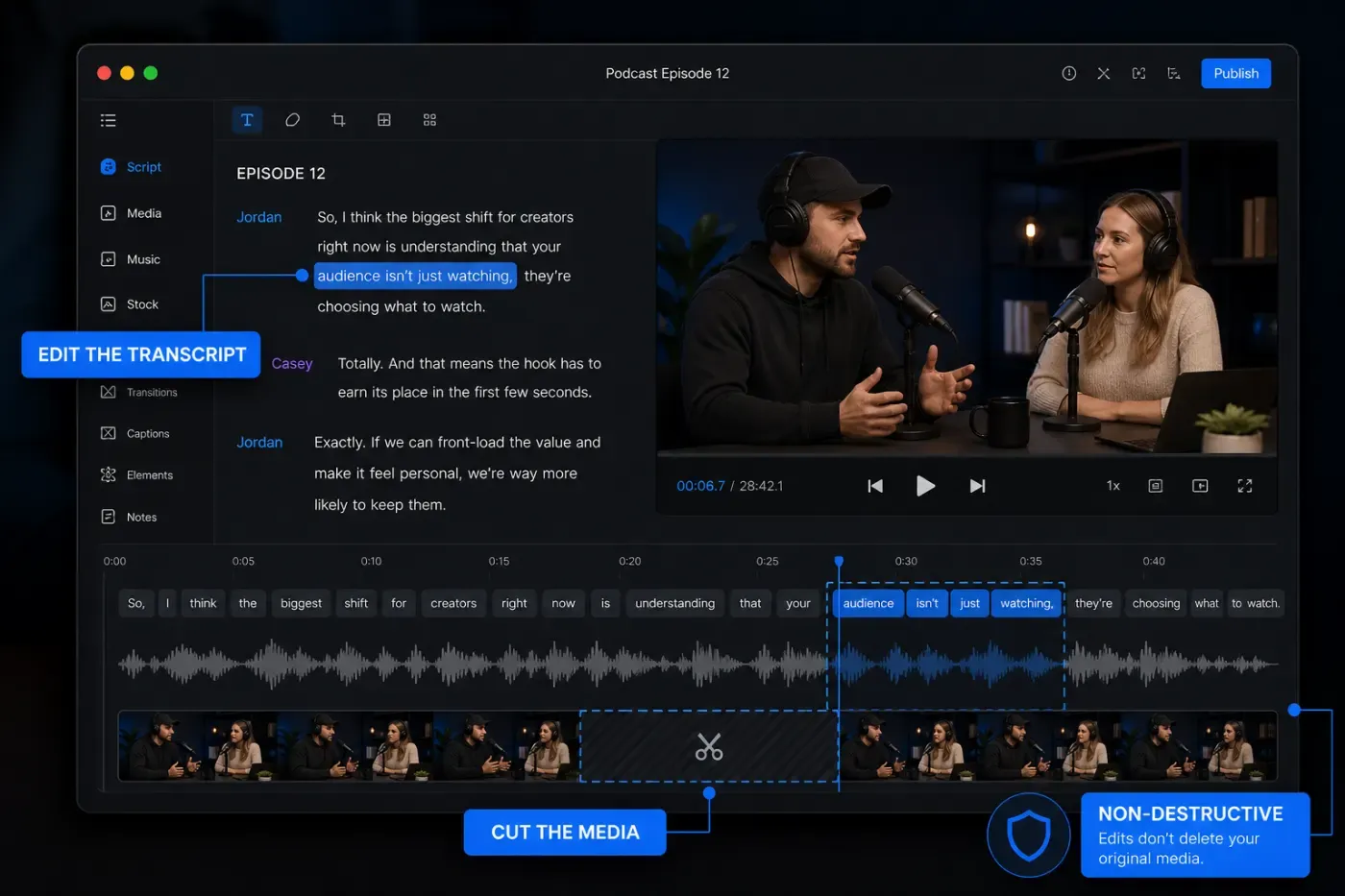
Open a recording and the transcript becomes the first place to cut. In Descript’s inline-notes documentation, deleting, moving or copying transcript text changes the linked audio and video non-destructively. The wordbar gives you a small timing control when a cut needs to be shorter or a speaker needs a breath. The original media stays available, which is reassuring when an automatic cut is too aggressive.
In practice, the workflow is three passes. First, read for meaning: remove false starts, repeated answers and the long detour that made sense during the recording but not in the final piece. Second, watch for rhythm: a transcript can hide a jump cut, a hand gesture or a visual beat that needs to remain. Third, use the timeline for finishing: place B-roll, adjust scenes, balance music and check the first and last frame. Descript makes the first pass faster; it doesn't make editorial judgment automatic.
The model works especially well for interviews because you can search the script for names, topics and repeated phrases. It is also useful for a screen recording where the narration tells you exactly where a mistake happened. It is less magical with music, non-verbal action and fast overlapping dialogue. Text is an index into media, not a complete description of what the viewer sees.
Transcription Accuracy and Correction
Descript's automatic-transcription guide names the variables that matter: microphone quality, background noise, accents, overlapping speakers and the selected model. The current pricing matrix lists transcription in 25 languages and detection for eight or more speakers, but that is a capability list, not an equal-accuracy promise. Speech becomes editable text and can drive captions and search, yet names, jargon, speaker labels and timing still need a human pass. Music and song lyrics are not a supported speech-transcription use case, and files longer than 15 hours fail automatic transcription.
Speaker labels are a useful start, not proof that every line belongs to the right person. In a two-person podcast, scan the handoffs and correct names before exporting captions or a transcript. A guest who says a product name, a URL or a technical term deserves the same check. Search is only as reliable as the spelling in the transcript, and a caption error can make a polished video look careless.
There is a second accuracy question: does a text cut preserve the picture? A filler word may be harmless when the speaker is on camera but awkward when the edit jumps to B-roll. After a heavy text pass, watch the cut with sound. Descript’s non-destructive model lets you restore or adjust a line, but it doesn't remove the need to audition the edit.
For social videos, CapCut’s auto-captions workflow is often faster because it starts closer to animated, platform-ready text. Descript is stronger when you want the transcript to remain the source of the edit and caption copy, then style the finished scenes with restraint.
AI Audio, Filler Words and Underlord
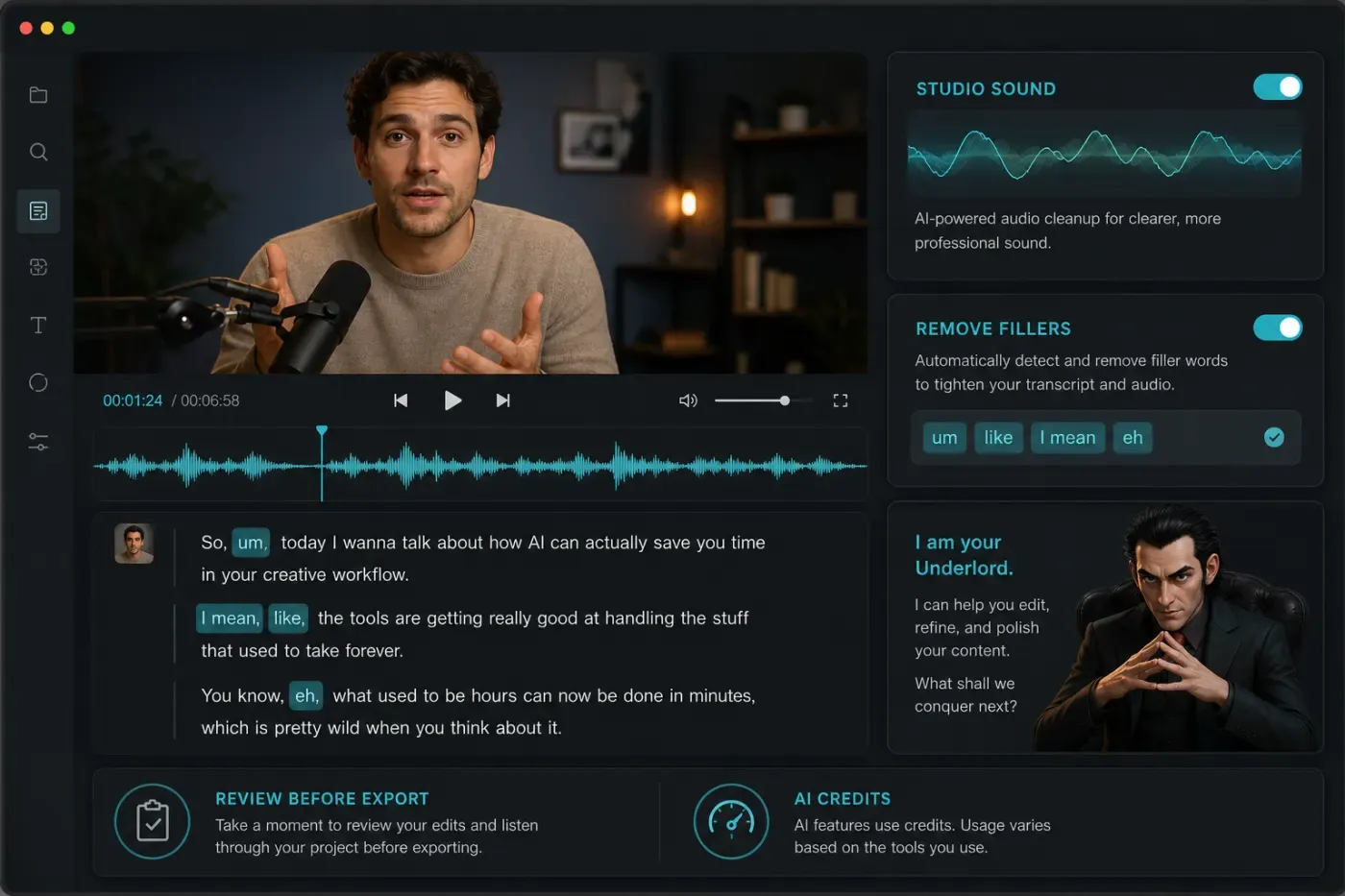
Descript's AI tools are practical when they shorten a repetitive cleanup pass. Remove Filler Words can detect words such as “um,” “uh” and “you know,” then let you preview and handle each suggestion. The current help page now describes this as an English-transcript feature; the earlier five-language claim is no longer current. It is a suggestion system, not a reason to erase every hesitation.
Studio Sound targets the harder problem: a voice recorded in an ordinary room. Underlord can help with editing and refinement, while other AI tools cover eye contact, green screen, AI speech and generated media. The current usage guide says Studio Sound and Remove Filler Words scale with the job but stop at a 30-credit ceiling per file and tool application. Thirty is the maximum, not a fixed charge. Underlord has no fixed price per action and can spend credits both on deciding what to do and on the tool it runs. A July 2026 community discussion contains sharply different experiences with credit use. Treat those as warning signals, not a typical rate; keep the Usage display visible during your own representative edit.
Use the tools in a controlled order: make the transcript cut, fix speakers and names, remove only the filler words that damage the pace, then audition Studio Sound on headphones. Listen for clipped consonants, pumping room tone and a voice that suddenly sounds synthetic. The best Descript workflow is still editorial: accept useful suggestions, reject the ones that change the speaker’s intent, and keep a clean original take.
Scenes, Layouts, Captions and Vertical Video
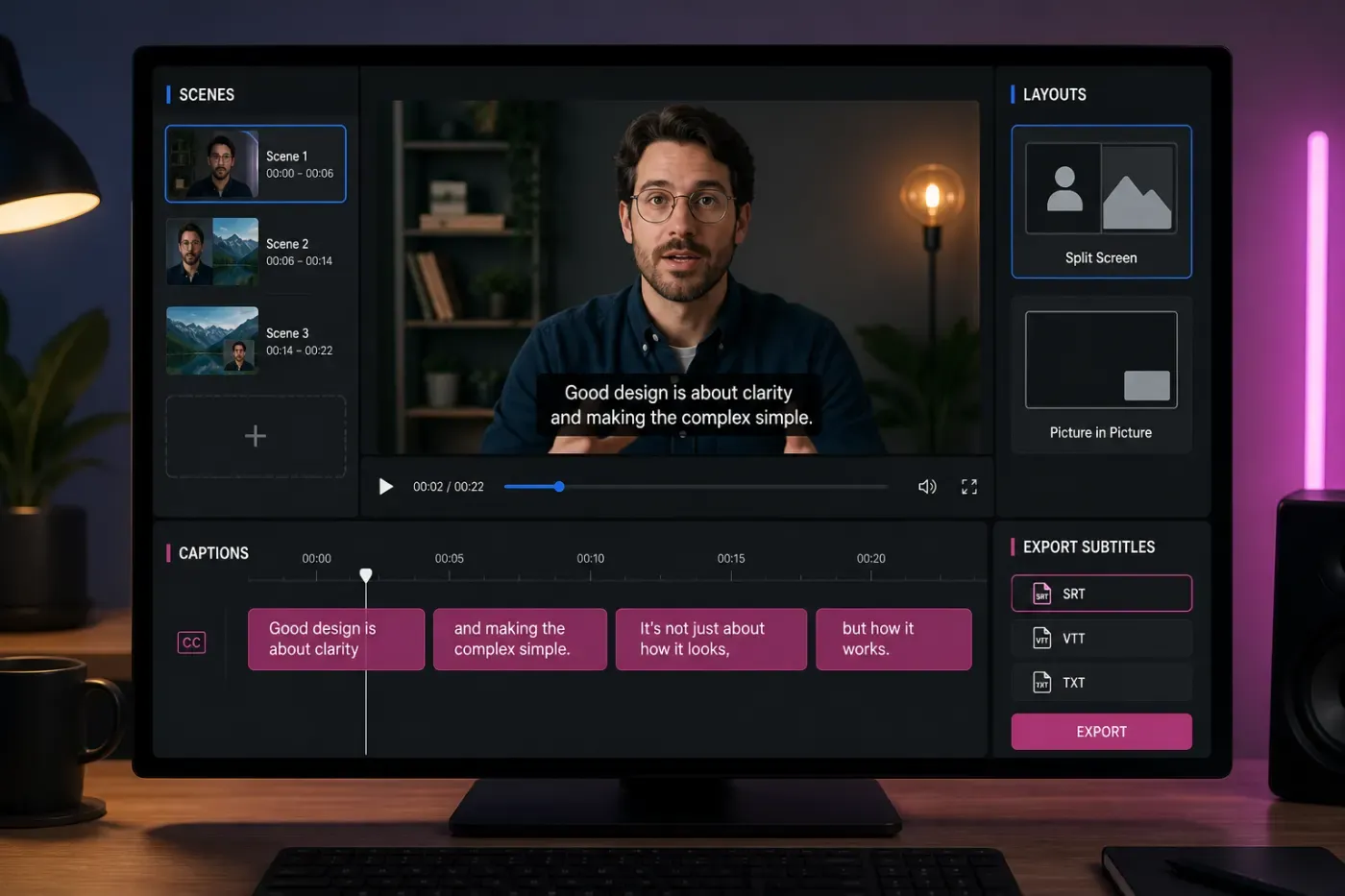
Scenes are Descript’s answer to the visual side of text editing. A scene can hold a talking-head shot, a screen recording, a title card, an outro or a split-screen layout. This is enough for a lesson, product walkthrough or podcast clip without forcing every visual decision into a single continuous timeline. A scene structure also makes it easier to create alternate openings and social cuts.
Captions are part of the transcript-to-video workflow, and Descript's export documentation lists subtitle and text files alongside video, audio and GIF output. The current pricing matrix also lists Dynamic Captions and layer animation on every plan. That closes more of the social-video gap than older reviews suggest. CapCut still has the broader trend-template, sticker and effect workflow, but it is no longer accurate to describe Descript as offering only plain transcript captions.
Descript can make a vertical scene, but the experience is more deliberate than a phone editor that starts in 9:16. Set the canvas, check safe areas and decide where the transcript-derived caption sits relative to a face or screen recording. If you publish many aspect ratios, keep a clean master scene and make platform versions after the story is locked. The CapCut export settings guide is useful for that final social handoff.
Pricing, Media Minutes and AI Credits
The current Descript pricing page shows a free plan and three paid tiers. In the US snapshot checked on September 4, 2026, Hobbyist is $16 per person/month with annual billing or $24 on monthly billing, Creator is $24 or $35, and Business is $50 or $65. Hobbyist lists 10 media hours and 400 AI credits per month; Creator lists 30 hours and 800 credits; Business lists 40 hours and 1,500 credits. Annual billing is displayed as the lower price, and the page says it can save up to 35%. These are dated US figures, not a worldwide quote.
Do not reduce the plans to “transcription hours.” Descript separates media minutes from AI credits. Uploading or recording audio/video consumes media minutes, still images count as one second, and unused monthly minutes do not roll over. Underlord, Studio Sound, filler-word removal, green screen, eye contact, AI speech, avatars and generated media consume AI credits; unused monthly credits do not roll over either. The current top-up guide limits top ups to Creator and Business, uses them only after the monthly allowance is exhausted and gives them a 12-month life. A long interview and several AI passes can therefore cost very differently from a short social clip.
The free plan is useful for testing the editing model. The September 4 pricing snapshot lists 60 media minutes per month, 100 one-time AI credits, 5 GB of cloud storage and 720p video export with a Descript watermark. The pricing FAQ says no card is required. Hobbyist lists 1080p watermark-free export; Creator and Business list 4K watermark-free export. Read the live matrix before quoting a client, especially if a watermark, upload-size ceiling, web-link duration or AI top up changes the economics.
Export, Watermark and Deliverables
Descript can export video, audio, GIF, text and subtitles locally. It can also make a shareable web page/embed and publish to supported destinations. That combination is useful for review: a client can watch a link, comment on a line and receive the final MP4 or subtitle file after approval. The project doesn't have to be flattened at the first review.
Export is where plan limits become visible. The current matrix lists 720p on Free, 1080p on Hobbyist and 4K on Creator and Business. It also caps video web links at one hour on Free/Hobbyist and three hours on Creator/Business. Check the exported file's dimensions, frame rate, audio and subtitle timing. A project preview can look fine while a platform upload exposes a wrong aspect ratio, missing captions or a lower-resolution setting.
For a repeatable handoff, name the master, caption file and vertical version separately. Keep the clean long-form export outside the social project, and preserve the source media until the client signs off. If you need another editor for finishing, Descript’s export and timeline handoff options are worth testing on a short section first; not every layout or AI treatment will translate identically.
Desktop, Browser, Cloud and Performance
Descript is not a mobile editor. The current system requirements page recommends macOS 14 Sonoma or newer, Windows 11 or newer, an Intel 7th-generation/Kaby Lake or Apple silicon M1-or-newer Mac processor, and Intel 7th-generation or AMD Ryzen 3000-or-newer on Windows. It recommends 16 GB of RAM, 32 GB for 4K or heavier work, 20 to 40 GB of free storage and a 50 Mbps down/10 Mbps up connection. The minimum is 8 GB RAM. Chrome, Edge and Opera are the officially supported Chromium browsers.
A phone can upload media, but the editing tools are intended for desktop or web. Mobile browsers, tablets, iPad and Chromebook are not officially supported editing environments. That is a meaningful CapCut difference: CapCut can follow a creator from phone to desktop, while Descript asks you to bring the project to a supported computer or browser.
The web editor is convenient for review and access. In a Descript engineering article updated July 29, 2026, the company says its WebCodecs engine powers the web app and newer desktop experience and reports average 4K exports two to three times faster in its own user data. That is useful vendor evidence, not an independent benchmark. Real performance still depends on codecs, RAM, storage, browser, network and project complexity.
Plan a test before a deadline. Import a representative clip, transcribe it, apply the intended audio cleanup, make a vertical scene and export the final resolution. If the project is 4K, leave storage for source media, caches and the rendered file. A browser editor can feel quick on a short proxy and become demanding once a long multi-camera recording is loaded.
Collaboration, Comments and Review Links
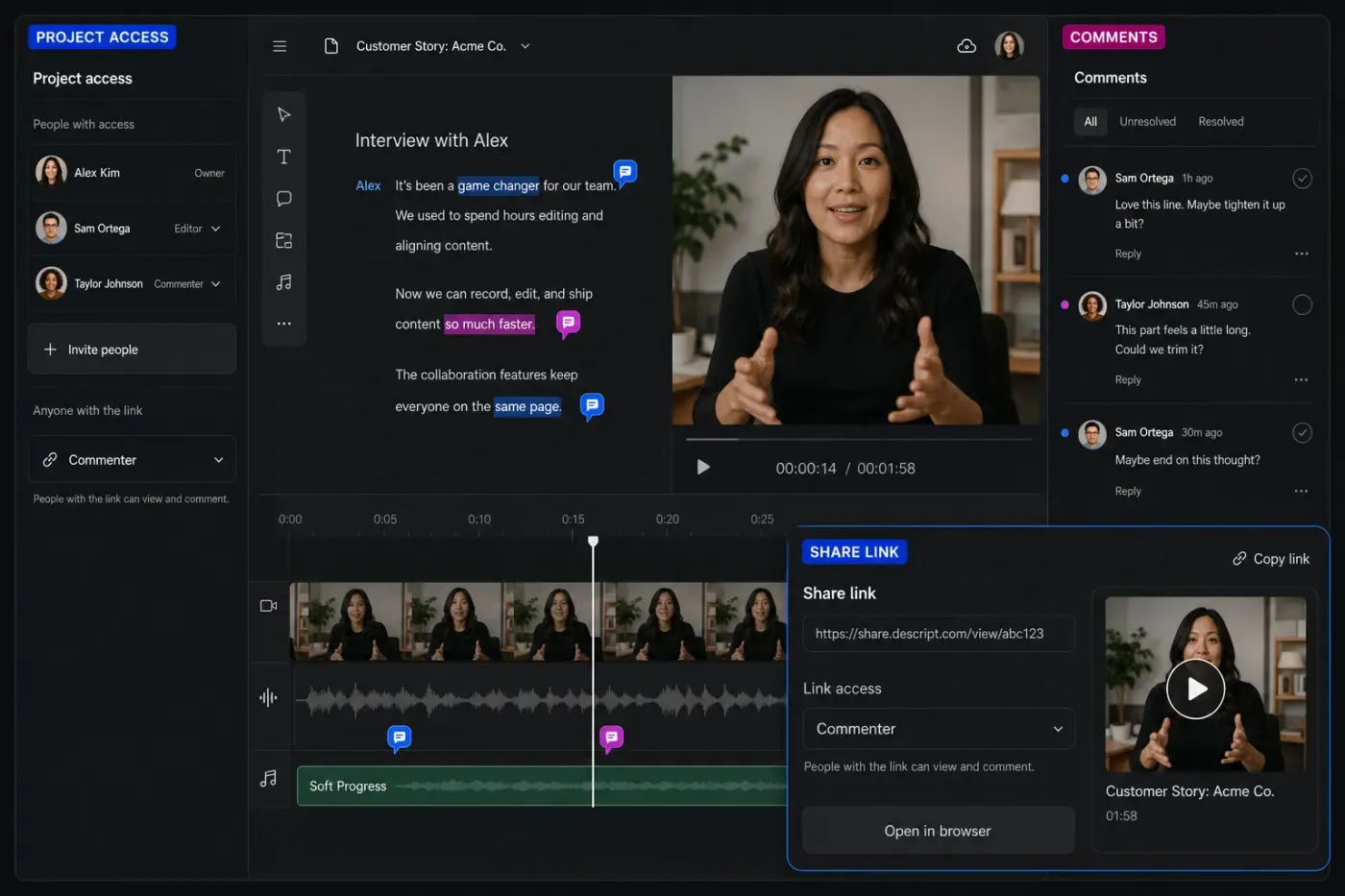
Collaboration is one of Descript’s strongest reasons to exist beside CapCut. Project access documentation separates roles such as commenters and editors. An editor can edit and export, but editor access doesn't automatically grant uploading, AI or translation permissions. That separation is useful when a client should approve a cut without spending the team’s media or AI allowance.
Comments can attach to transcript text or a moment in the project. A reviewer can write “tighten this answer,” “add the product close-up” or “leave the pause here” next to the relevant part of the edit rather than sending a timestamp list by email. Private project comments and comments on a published page are different, so choose the link type deliberately.
Project links normally require a signed-in account and permission because they expose the full project. An exported Descript web link can be viewable without an account when its access setting allows it. The current official pages conflict on commenting: the project-link guide says non-users can view and comment on a web link without an account, while the web-link documentation says public-page comments require a login or free account. Do not promise either behavior from documentation alone. Open the exact link in a signed-out window, post a test comment and remove it before sending the page to a client.
Descript vs CapCut: Feature Comparison
| Workflow question | Descript | CapCut |
|---|---|---|
| Best starting point | A transcript of a conversation, lesson, screen recording or podcast. | A phone clip, template, effect, beat or social format. |
| Core editing speed | Fast rough cuts by selecting, deleting and moving words. | Fast visual cuts, templates, captions and effect presets. |
| Transcription and captions | Editable transcript drives the media cut; current plans list Dynamic Captions, but accuracy still needs review. | Auto captions sit inside a broader mobile social-template and effect workflow. |
| AI cleanup | Studio Sound, filler-word removal and other AI tools use credits. | Broad mobile/social AI and effect tools; exact features vary by plan and platform. |
| Layouts | Scenes, split screen, picture-in-picture, titles and screen recordings. | Large template and effect library with quick vertical variants. |
| Collaboration | Transcript/time comments, role-based project access and review links. | Cloud/account workflows, with the strongest everyday experience aimed at social creation. |
| Platforms | Desktop app and supported Chromium browsers; no official mobile editing. | Mobile, desktop and web options for a more device-flexible social workflow. |
| Best project | Interview, podcast, course, webinar, narrated screen recording or client review. | Short-form social post, trend edit, caption-heavy clip or template-led campaign. |
Choose Descript If You...
- Make interviews, podcasts, lessons, webinars or screen recordings where spoken words carry the story.
- Want to cut a rough edit by reading the transcript instead of scrubbing every pause.
- Need searchable transcripts, subtitle files and a review process that keeps comments next to the edit.
- Work on a supported Mac, Windows PC or Chromium browser and have a reliable connection for cloud processing.
- Can budget media hours and AI credits, and will check the final audio and captions before export.
Stay With CapCut If You...
- Publish mostly from a phone and want editing to work on mobile without moving to a desktop.
- Need animated captions, templates, stickers, effects and trend formats more than transcript search.
- Turn short clips around quickly for TikTok, Reels, Shorts or a client’s social calendar.
- Want a generous free-first experiment before paying for media capacity or AI usage.
- Rely on many aspect-ratio variants and platform packaging rather than long-form dialogue editing.
A Practical Descript and CapCut Hybrid Workflow
A hybrid works when the handoff has a clear purpose. Record or import the interview in Descript, clean the transcript, remove only the filler words that help the pace, balance the dialogue and build a clean master. Export the long-form video and subtitle file. Then bring a copy into CapCut for the 9:16 cut, animated captions, platform-safe margins, a trend sound or a final template treatment.
Keep the Descript project as the editorial source and the CapCut file as a publishing version. Don't let a quick social change overwrite the approved master. If the client asks for a new quote or a different answer, fix the source transcript first, export a new master and regenerate the social cut. That simple separation prevents a caption tweak from becoming a lost interview edit.
For browser finishing, our CapCut web editor guide explains where the desktop handoff fits. For a wider decision, return to the alternatives hub after deciding whether your next project is a conversation or a trend.
Frequently Asked Questions
Is Descript better than CapCut?
Descript is better for transcript-led editing, talking-head videos, podcasts, screen recordings, audio cleanup and review comments. CapCut is better for mobile-first social edits, templates, animated captions and trend effects. The winner depends on whether your bottleneck is finding the story or packaging it for a feed.
Is Descript free?
Yes. The pricing page checked on September 4, 2026 lists a $0 plan with 60 media minutes per month, 100 one-time AI credits, 5 GB of storage and 720p video export with a Descript watermark. Paid Hobbyist, Creator and Business limits differ; check the regional price and current matrix before subscribing.
Does Descript edit on iPhone or Android?
Not as an official mobile editing environment. The current system-requirements page says phones can upload media, while editing tools are supported on the desktop app and Chromium-based browsers. Mobile browsers, tablets, iPad and Chromebook are not officially supported for editing.
Does Descript have automatic captions?
Yes. Descript turns speech into editable text that can be used for captions, and it can export subtitle files. You still need to correct names, speaker labels, timing and words that the recording makes hard to recognize. CapCut usually reaches animated, social-ready caption styling faster.
What are Descript media minutes and AI credits?
Media minutes track uploaded or recorded audio/video, while AI credits power tools such as Underlord, Studio Sound, filler-word removal, green screen, eye contact, AI speech, avatars and generated video. The two allowances are separate, unused amounts don't roll over, and longer files or heavier AI operations can use more of the pool.
Can a client review a Descript project without editing it?
Yes. Descript supports project commenters, project editors and exported web links. Project links normally require a signed-in authorized account; a suitably configured web link can be viewed without one. Because Descript's current help pages disagree about whether a web-link commenter must sign in, test the exact link in a signed-out window before sending it to a client. Give the reviewer the narrowest access that works.
Final Verdict
Descript is a focused CapCut alternative for creators whose raw material is speech. Its transcript-driven cuts, searchable script, scenes, subtitle export, AI audio tools and review comments can remove a large amount of friction from interviews, podcasts, courses and screen recordings. The current plan system is more involved than a simple “free versus paid” label: media hours, AI credits, seats, export resolution and billing cycle all affect the real cost.
CapCut remains the smarter choice for phone-first social publishing, kinetic captions, templates and trend velocity. Descript is the smarter choice when the edit begins as a conversation and the team needs to read, revise and approve it. If your channel needs both, build the story in Descript, preserve that master, and use CapCut for the version that belongs in the feed.