

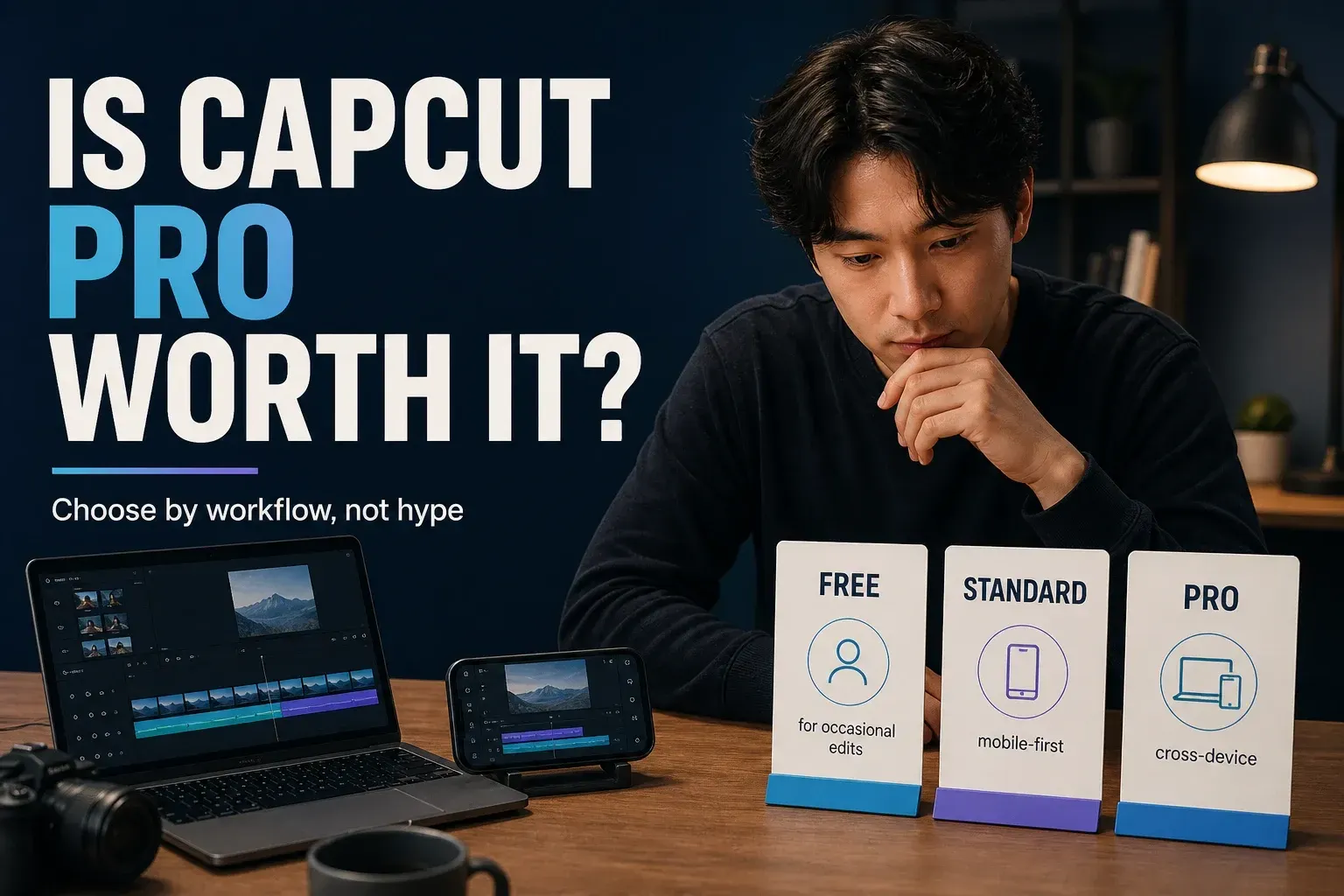
CapCut Pro is worth it when a specific paid feature helps you finish a video you value enough to cover the full cost. Regular captioned client work can justify it. So can one demanding project or a deliberate hobby purchase. If your edits already work with free tools, keep Free.
Our recommendation: decide from one representative project, not a feature count. For a new or temporary workload, compare a monthly commitment first. Consider annual only after you know the tools fit and the full annual charge beats paying for the months you actually need.
Documentation checked September 15, 2026. This is an editorial buying guide, not a paid-account test or a benchmark. The examples below are hypothetical; no measured savings or generated results are claimed.
Who should pay, and who should wait?
- You make occasional personal videos: start with Free. Replace an optional paid transition or template if the substitute looks good enough. A premium effect you genuinely enjoy can still be worth a small, planned hobby expense.
- You deliver captioned client clips regularly: consider Pro if the exact caption styling, cutout or other paid tool reduces your total editing work. Count correction and review time, and check client permissions before uploading footage.
- You have one deadline-driven project: one paid month can be reasonable when the required effect or workflow is worth the cost. Recurring use is not a prerequisite, and a single job is not a reason to commit to a year.
- You already subscribe to another editor: pay only for useful work it cannot cover conveniently. Include the time needed to transfer media and finish the project elsewhere.
- Your problem is crashing, missing media or an unsuitable workflow: solve that first. A subscription is not evidence that the fault will disappear; use the CapCut troubleshooting guides.
Use one project to make the decision
Choose a short edit that represents your actual work, with your usual captions, audio, effects and delivery requirements. Keep the original and work on a duplicate. Use non-confidential media for an evaluation.
- Build the free version first. Note the precise tool, asset or export option that asks for payment. Do not assume a feature is paid everywhere because another account shows a Pro badge.
- Separate requirements from preferences. An agreed client style may need a specific effect; your own travel clip may work with a free substitute. Check that the blocked item is included in the offer on the device you will use.
- Estimate the complete job. Include caption corrections, cutout cleanup, failed AI attempts, final review and any handoff to another editor. A quick preview is not the same as an acceptable delivery.
- If you choose an eligible trial or paid evaluation, inspect the finished export. Check words, timing, audio, resolution and visible marks outside the editor. Do not activate an offer until you understand its charge and renewal terms.
- Set a decision date before renewal. Keep the source media, editable project backups and finished files somewhere independent of the subscription.
Count net time saved, not generation speed
Net time saved = manual work avoided minus corrections, retries and extra handoff work. For example, a hypothetical tool that avoids 90 minutes of manual editing but adds 30 minutes of cleanup saves 60 minutes. This is arithmetic, not a CapCut performance claim.
For paid work, multiply those net hours by a realistic value for your time, then compare with the subscription and any extra credits, storage or seats you need. Do not assume recovered time becomes billable work. For a hobby, decide whether the result and enjoyment are worth the expense without pretending the purchase must earn money.
Free, Standard or Pro: buy the missing benefit
CapCut's official plan comparison positions Standard as mainly mobile and Pro as the broader mobile, desktop and web option. Standard is a separate paid offer, not another name for Free. Availability and included tools depend on the offer you can actually access.
Free is the starting point when your current tools finish the job. Standard is worth comparing for a phone-first workflow if its stated benefits remove your particular restriction. Pro is worth considering when you need confirmed premium tools or cross-platform benefits that the smaller offer does not provide.
Use the Pro features guide to investigate a specific tool. Do not buy Pro solely for a headline such as “4K” or “AI captions”: the relevant export options, feature availability and charges need checking on your device and account.
For a phone-to-computer workflow, subscription access and project transfer are separate checks. CapCut warns that different sign-in methods can create different accounts despite the same email. The multi-device guide explains account identity and local-versus-cloud projects. Do not budget for effortless transfer until a non-critical duplicate works on the second device.
For colleagues, Teams uses seats. A personal Pro subscription is not proof that every collaborator has paid access. Review the separate team offer if shared work is the reason for buying.
Include AI usage and storage in the value test
Pro does not mean unlimited AI. The Credit Rules distinguish subscription, activity and purchased credits. Check the displayed cost for the configured action before confirming it. Do not infer that every caption operation costs credits merely because it uses AI.
Budget for plausible retries, but judge the useful output rather than the number of generations. If the tool's results need extensive repair, the subscription may add expense without reducing the work. Our AI credits guide covers balances, expiry and conflicting official help pages; this buying decision does not require a second credit manual.
Storage is also part of the offer, not a universal number. CapCut's updated membership announcement describes a Pro upgrade from 100GB to 1TB and from 550 to 1,200 AI credits. Its monthly and yearly plan article still describes 100GB. The announcement explains the changed plan, but it does not prove every existing account has migrated. Check the allowance stated for your plan and the quota in the Space you intend to use.
Extra cloud capacity has value if it solves a real transfer or storage problem. It is not an independent backup. CapCut's US terms warn that paid cloud capacity is suspended when the subscription ends. Preserve the editable project and source media before expiry; a rendered video cannot replace them.
Monthly or annual: compare the full commitment
For current amounts, use our CapCut pricing comparison. CapCut's pricing notice says the final payment amount varies by region, platform and taxes.
Compare the full annual charge with monthly payments for the months you expect to use Pro, using matching benefits and taxes. An advertised monthly equivalent on an annual offer is not a promise of monthly billing. Include any additional usage costs in both options.
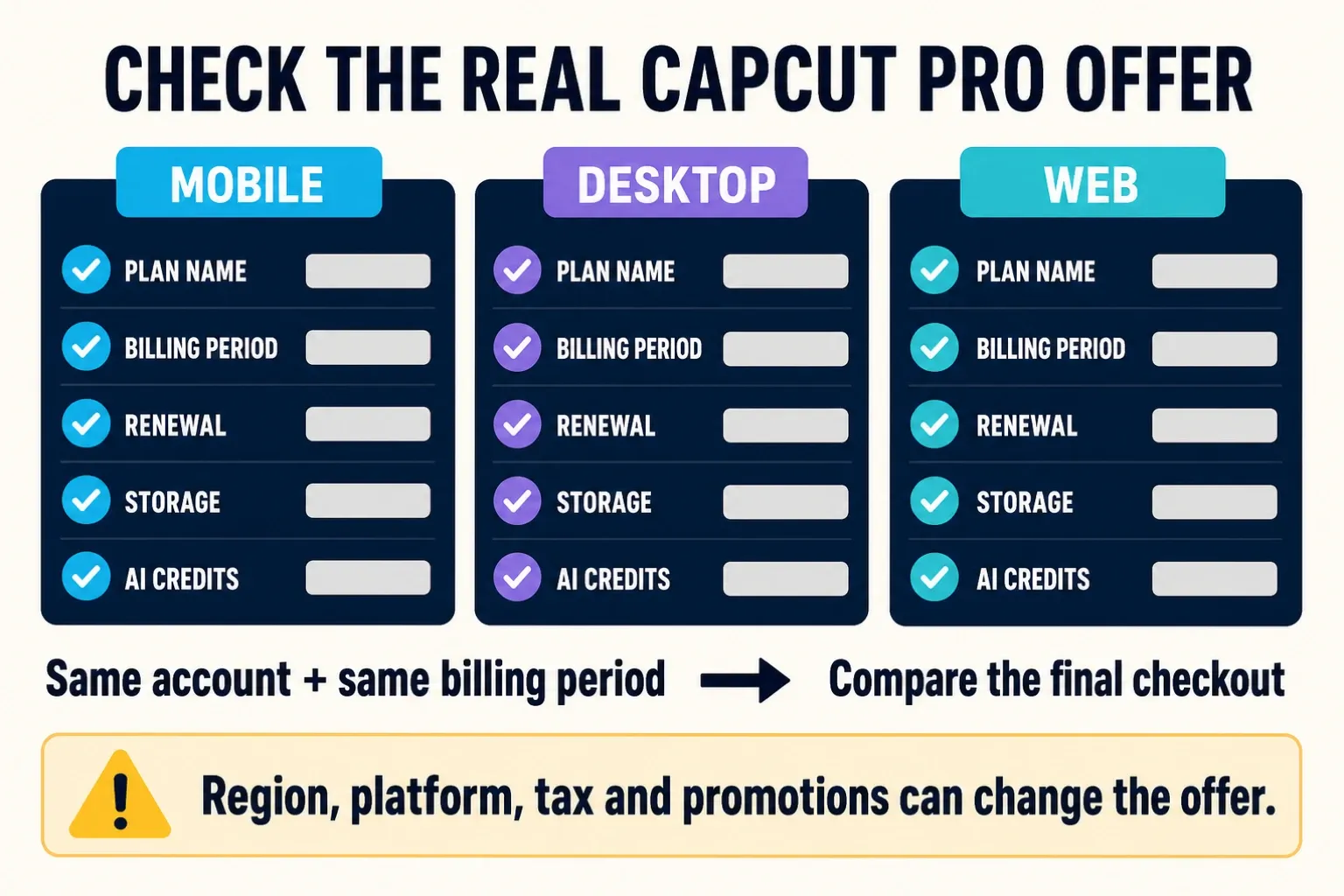
Monthly is a reasonable first choice for seasonal work, one campaign or an uncertain workload. Annual becomes a candidate when you have evidence of sustained use and its total is lower. Check renewal separately from an introductory discount, and do not budget on receiving a refund for unused months.
CapCut documents a seven-day trial for eligible users in supported regions, not a guaranteed free week for everyone. If the offer does not explicitly show a trial, do not assume one. Read our trial and renewal checks before accepting.
CapCut's renewal guidance says to cancel at least 24 hours before renewal. Set your reminder earlier and follow the company that billed you. Cancellation and refund eligibility are separate. For example, Google Play's trial conditions say cancellation ends access immediately unless stated otherwise.
Client work: check rights before calculating savings
Pro access does not clear every template, effect or music track for every destination. The US Materials License Agreement distinguishes personal-only materials from labelled dual-use materials. Commercial permission can be limited by use, territory and duration. Mixing personal-only materials into a commercial edit does not become permitted because you pay for Pro.
The agreement limits Commercial Sounds to CapCut, TikTok and TikTok for Business; use elsewhere requires separate rights. For a monetized YouTube video or Instagram campaign, use music you own or have licensed for that destination rather than treating the Pro badge as permission. Check the regional agreement and asset terms that apply to your work.
Confidential footage needs a separate decision. The US terms dated April 15, 2026 say CapCut does not own your User Content, but describe it as non-confidential and grant a broad service license. Ownership does not mean confidentiality. Do not make confidential client material available through a workflow the client has not approved. Calling a draft “local” is not sufficient evidence about every cloud or AI operation.
When another editor is the better next step
If you mainly want more detailed desktop color or audio control, compare DaVinci Resolve for CapCut users. Blackmagic's official product page describes dedicated editing, Color, Fusion and Fairlight workflows on Mac, Windows and Linux. Check hardware requirements and Free-versus-Studio restrictions before moving a project; this is a workflow alternative, not a claim that every feature is free.
If you want a simpler phone editor, or need a browser-based workflow instead, use the alternatives organised by editing task. Evaluate the same short project and include the learning and transfer work. Avoid buying another subscription merely to escape one replaceable premium asset.
The decision before your next renewal
Keep Pro if the last paid period produced enough useful work or enjoyment to justify another one. Pause the commitment when the next period has no clear use. If you decide to stop, follow the cancellation guide for your billing provider and retain the confirmation. For subscription access, trials and other account questions, return to the CapCut Pro guides.
CapCut Pro worth-it FAQ
Is CapCut Pro worth it for beginners?
Start with Free while you learn what you need. Paying can make sense when a specific paid benefit is worth the cost, even for one project. A subscription will not teach editing or guarantee a better result.
Is one month of CapCut Pro worth it for a single project?
It can be, if the required tool or result justifies the full month's cost. Check that the offer includes the benefit you need, allow for extra usage costs, and plan for backups and renewal before subscribing.
Is CapCut Standard the same as Free?
No. Standard is a separate paid offer. CapCut positions it mainly for mobile editing, while Pro has broader cross-platform benefits. Check the available offer rather than assuming every tool is included.
Does Pro include unlimited AI generation?
No. Some AI actions use metered credits in addition to plan access. Check the cost of the configured run and its available balance; include retries and correction work when deciding whether Pro is worth paying for.
Does every Pro subscriber get 1TB?
Do not assume so. CapCut's updated-plan announcement describes an upgrade from 100GB to 1TB, while another plan article still lists 100GB. Check your plan's stated allowance and the quota in the intended Space.
Can Pro music be used in monetized YouTube videos?
Pro is not blanket music clearance. The US Materials License Agreement limits Commercial Sounds to CapCut, TikTok and TikTok for Business; other destinations require separate rights. Check your applicable agreement and use music licensed for YouTube.
Is an annual plan always better value?
No. Compare the annual charge with monthly payments for the months you expect to need Pro, with matching benefits and taxes. Monthly limits the commitment for uncertain use; annual may cost less for sustained use.
Can I try Pro without committing to a paid renewal?
Only accept a trial when your eligible offer explicitly shows one and you understand its renewal terms. CapCut documents a seven-day offer in supported regions and advises cancelling at least 24 hours before renewal. Cancellation can affect trial access, so read the billing provider's conditions first.