

Finding a CapCut trending template is easy. Finding one that still opens, fits your footage and exports cleanly takes a little more work. CapCut can show a use count or place a template on a Trend shelf, but neither signal tells you when the template was created or whether your audience is tired of it.
Quick answer: Search the current Templates area on Mobile, Desktop or Web, then check TikTok posts that carry a real Use template in CapCut link. Open the exact result, count its media slots, review the audio and paid labels, and test a short export. Current CapCut help documents template search on Mobile, PC and Web, although individual results can still vary by account, region and version.
This page is a discovery and verification method, not a static “top 20” list that goes stale. If you already have a working link and need the replacement and export steps, use our full CapCut Templates guide.
What “Trending” Tells You
A trending label is a discovery signal, not a promise of future reach. CapCut doesn't publish a universal ranking formula, a fixed TikTok-to-CapCut delay or a public metric for when a template “peaks.” We found no official basis for claims such as “it will appear in Trending within 24 hours” or “under 100,000 uses means early.”
Use the labels you can see, but read them narrowly:
- Trend or Trending means CapCut is surfacing the template in that current page or shelf.
- New is useful only when the current listing carries that label.
- For You is a recommendation area, not a chronological feed.
- Use count shows accumulated activity on that listing. It is not an upload date, growth rate or saturation score.
The practical question is not “Will this go viral?” It is “Can I make a post that suits this structure, and does the template work for the account and platform I will use?”
A Dated Example from CapCut Explore
On August 14, 2026, CapCut's public Trend Templates page visibly listed cards including “Trending capcut” at 2.4M uses, “Viral Song Slowmo” at 2.1M and several other results around 1.3M to 1.4M. Those numbers prove that the cards had activity when checked. They don't reveal creation dates or tell us whether use was still accelerating.
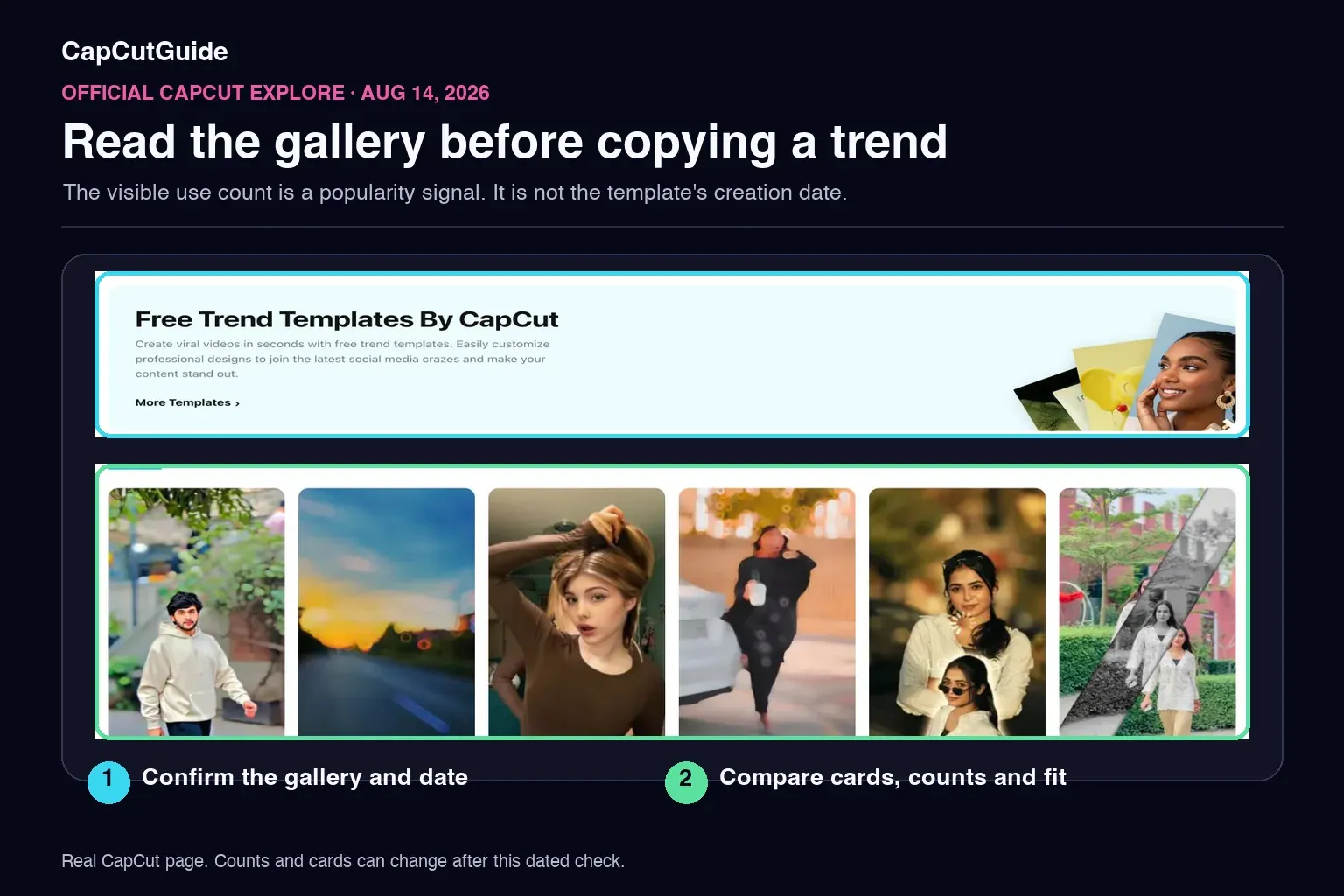
Use a dated gallery snapshot as a shortlist, then preview the exact card. A template with millions of uses may still work for a specific product, location or niche audience. A lower count may be genuinely new, or it may simply have weaker distribution in that region. The number alone can't decide.
How to Search CapCut Trending Templates
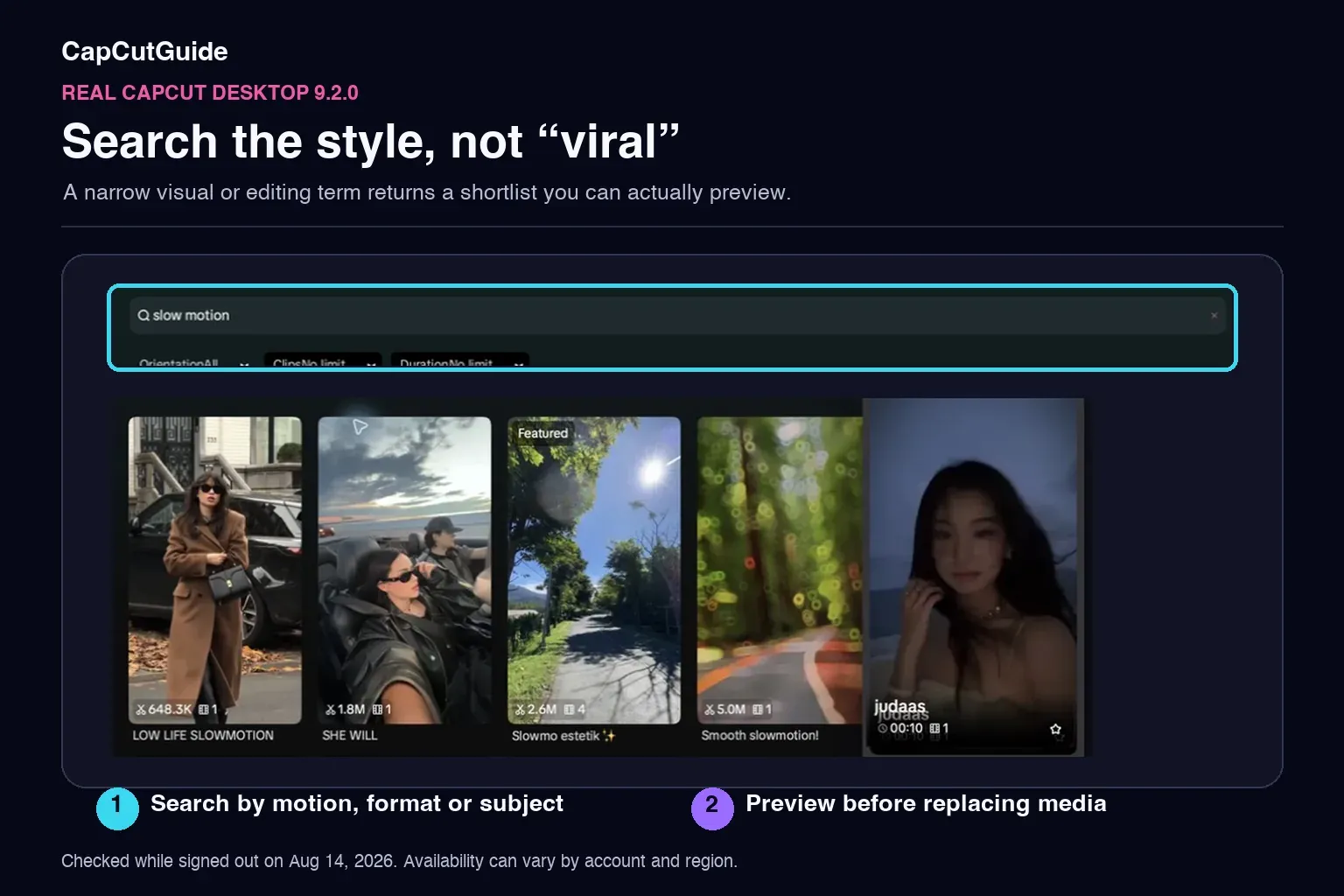
Start with the result you want to make. Search by movement, content type, number of clips, subject or visual style: slow motion walk, three photo beat, travel recap, product reveal, lyrics or before and after. “Viral” and “trending” produce broad, repetitive results.
CapCut's current instructions use the same basic route across platforms:
- Mobile: open Template if it is available, then search at the top of the template area.
- Desktop: open Templates, enter the keyword and choose Use template.
- Web: open Templates, search and choose a result that opens in the online editor.
We also checked CapCut Desktop 9.2.0 while signed out on August 14, 2026. Searching slow motion returned template cards and a working Use template action. This confirms the route in the checked build, not identical availability for every account.
| Platform | Best discovery route | Check before editing |
|---|---|---|
| Mobile | Templates area and TikTok handoff | Tab availability, clip slots and Paid/Pro labels |
| Desktop | Templates search in the current installation | The exact result opens and its placeholders are editable |
| Web | Templates search and public Explore pages | The card opens in the online editor for your account |
If search is empty, simplify the phrase and confirm that the wider gallery loads. CapCut's template search troubleshooting notes that results can be affected by login, region, network and browser conditions. Don't assume one empty query means the entire catalog is unavailable.
For slow-motion-specific choices and frame-rate checks, continue with our CapCut slow motion template guide.
Use TikTok as a Second Discovery Route
TikTok helps when a video carries a real CapCut handoff. Search for the song, edit type or subject, then look for Use template in CapCut on the video. Open the link and confirm that it lands on a template preview, not a copied caption or unrelated download page.
CapCut's TikTok handoff guide treats this as a Mobile route. A recent TikTok post can still reuse an old template, so the post date is not the template's creation date. Save the original post and exact template URL if the structure is useful; a guessed title is much harder to recover later.
Pinterest, Reels, Shorts and creator portfolios can help name a style. They are weak availability checks. Return to CapCut and make sure the exact asset still opens for the account that will use it.
Verify a Template Before Building the Post
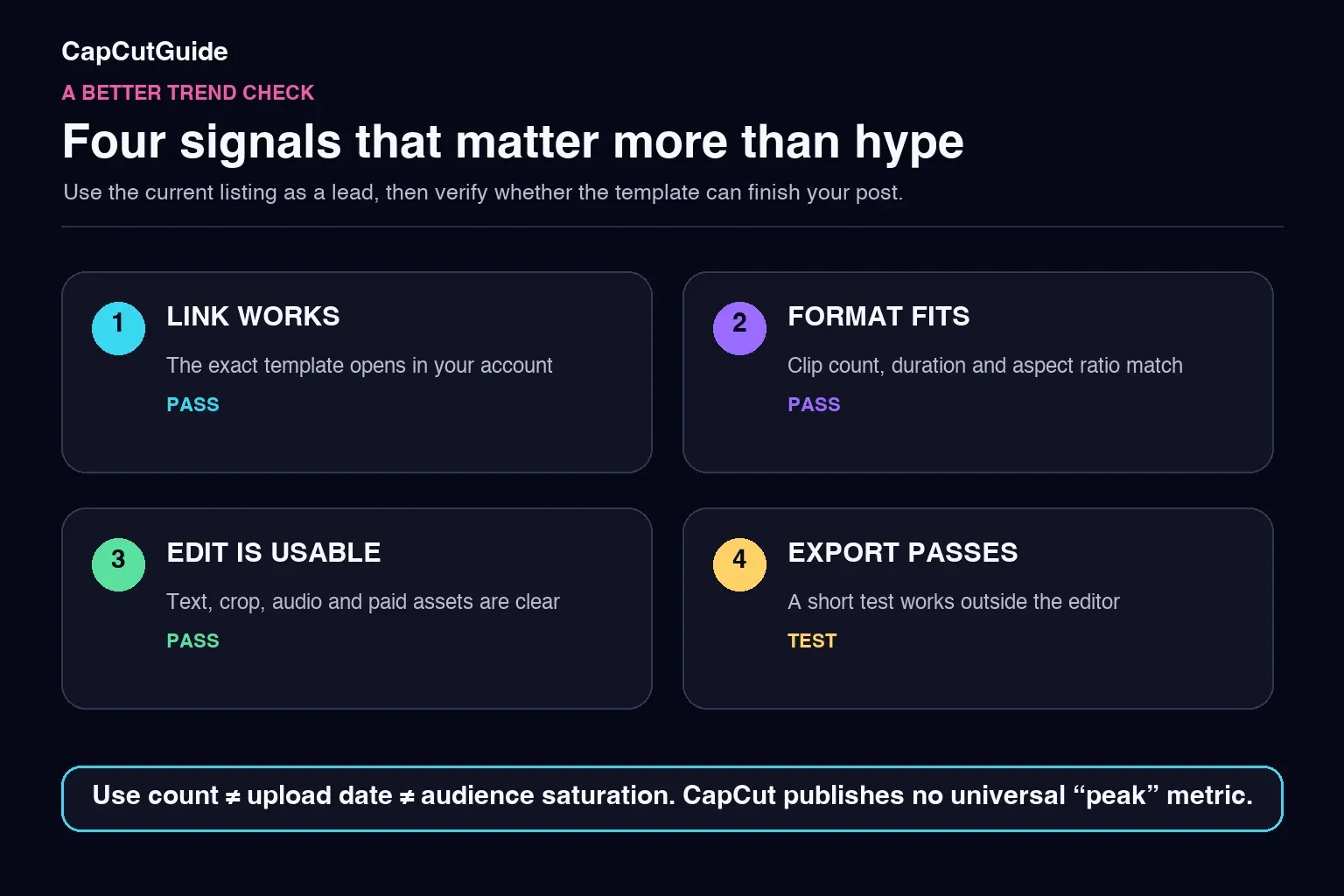
Don't judge a template from the cover frame. Open it and run four checks:
- The link works. The exact result opens now, in the account and region that will edit it.
- The format fits. The clip count, duration, aspect ratio and pace suit the footage you have.
- The edit is usable. Text can be changed where needed, the crop is acceptable, audio is available and any Paid or Pro asset is clear.
- The export passes. Two or three representative clips survive a short export without a surprise prompt, broken media or timing problem.
Following a creator can make discovery faster when you consistently like their pacing and slot structure. Treat that as editorial screening, not a platform advantage. A reliable recent link doesn't guarantee early access, future availability or better reach.
For a concrete single-template workflow, the Healing Thailand template walkthrough shows how to check slots and the handoff before replacing media.
When to Skip a Trending Template
Skip the template when the structure fights the footage. Common warning signs are a fixed portrait crop that cuts off the subject, more clip slots than you can fill well, text that can't be changed, an unavailable audio track or a speed change that makes the source footage look rough. Popularity doesn't repair those problems.
Also skip it when the template adds work without saving a real editing decision. If you need to replace the music, rebuild every transition, change all timing and remove most effects, a normal project will be faster and easier to maintain. Use the template as a reference for pacing, then recreate only the parts that help the story.
For branded or client work, check whether the template leaves enough control over typography, colors, safe areas and approval changes. A short personal post can tolerate a fixed structure. A campaign with several aspect ratios and revision rounds usually needs a reusable normal timeline instead.
Why a CapCut Template Link Stops Working
Separate one dead asset from a wider access problem. If one link fails while other templates open, the result may have been removed or may be unavailable to that account or region. If every template link and the catalog fail, check the app version, connection, sign-in state and supported-link handling.
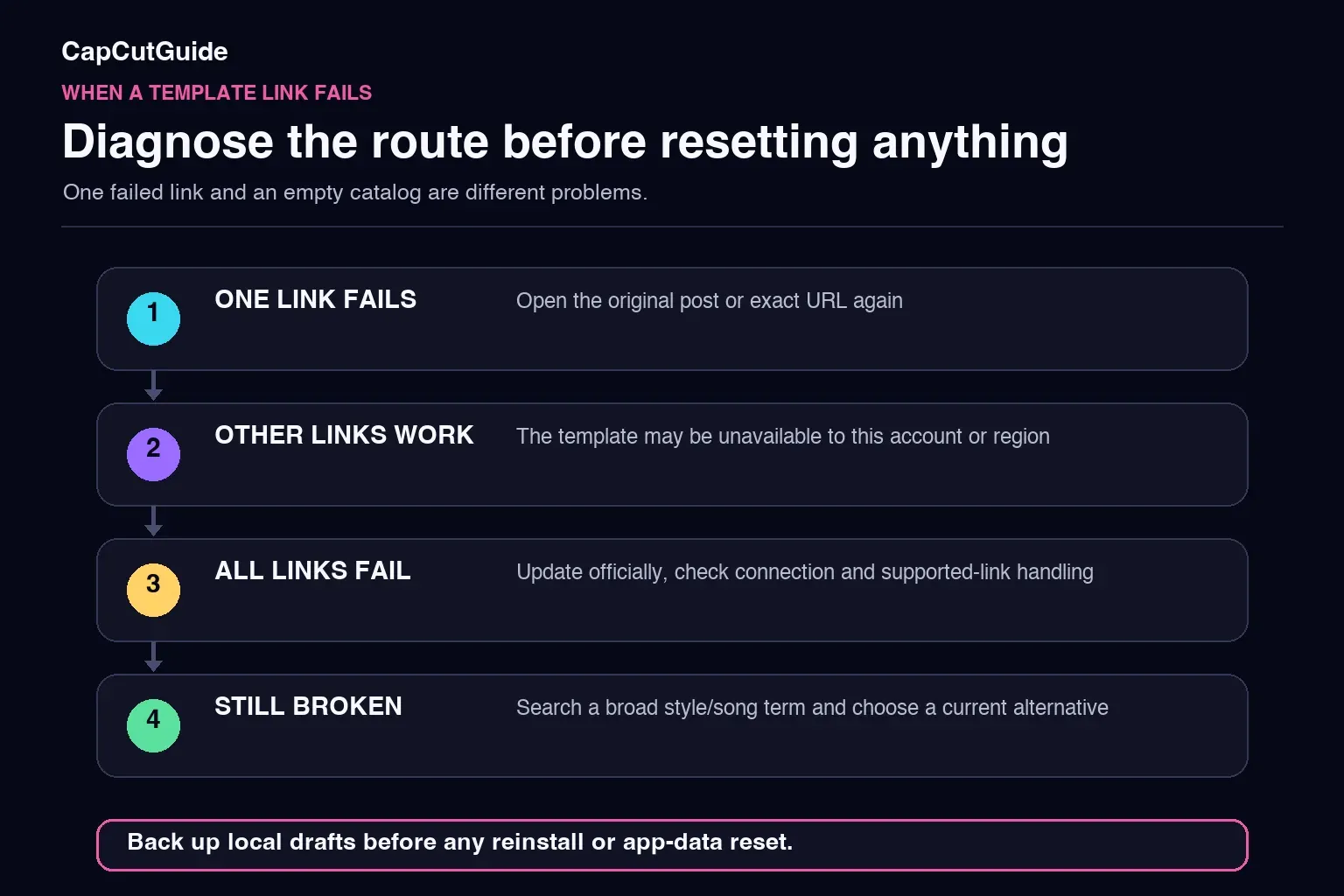
- Open the original post or exact template URL again.
- Test another known template in CapCut.
- Update CapCut and TikTok from their official stores, then retry on a stable connection.
- On Android, check whether CapCut is allowed to open its supported links.
- If the original remains unavailable, search the song or style and preview a current alternative as a separate asset.
A reinstall or app-data reset is not an early troubleshooting step because local drafts can be at risk. Back up or sync work first. CapCut's missing-template guide is the safer starting point when the entire Templates area is absent.
Paid, Pro and Commercial Use Are Separate Checks
A template can be free while containing an asset that produces a Pro prompt. A Paid label, template price, music rights and permission to use the final video commercially are also separate questions. Don't treat one “free” or “commercial” badge as clearance for every element in the edit.
CapCut's current paid-template help says paid-template discovery and purchase use Mobile, and a detail page can show price and licensing terms. Read the exact listing, then review the music, imported media, fonts and brand assets separately. If a watermark or paid-asset prompt appears at export, use our CapCut watermark guide to distinguish a removable ending clip from a restricted asset.
CapCut Trending Templates FAQ
How do I find trending CapCut templates?
Search the current Templates area on Mobile, Desktop or Web, and use TikTok videos with a real Use template in CapCut link as a second route. Search by style, motion, subject or clip count, then verify the exact result before planning the post.
Can I find CapCut templates without TikTok?
Yes. CapCut documents template search on Mobile, PC and Web. TikTok is an additional discovery route, not a requirement. The visible catalog can still vary by account, region, version and platform.
Does a high use count mean a template is overused?
No. It shows accumulated activity on that listing. It doesn't reveal the upload date, growth rate or how often your specific audience has seen the format. Use it as context, then judge fit and freshness for your audience.
How do I know whether a CapCut template is new?
Use a visible New label or a dated original creator post when available, but don't infer age from the use count alone. CapCut doesn't publish a universal release cadence or public peak metric.
Why is my CapCut template link not working?
The specific result may be unavailable, or the problem may involve region, account, app version, connection or link handling. Test another template first. If only one fails, search for a current alternative; if all fail, troubleshoot access before resetting the app.
Are trending CapCut templates free?
Many are free, but paid templates and templates containing Pro assets also exist. Review the exact listing and export summary. Template price, premium assets, music rights and commercial permission are separate checks.
Do trending CapCut templates work on Desktop?
Current CapCut help documents Templates, search and Use template on PC, and we verified the route in Desktop 9.2.0 on August 14, 2026. A particular template can still be unavailable or behave differently by account, region, version or source.